Douglas C-9 Skytrain II
Aircraft of the U.S. Navy
Entwicklung
The McDonnell Douglas DC-9
is an American five-abreast single-aisle aircraft designed by the
Douglas Aircraft Company. It was initially produced by the developer
company as the Douglas DC-9 until August 1967 and then by McDonnell
Douglas. After introducing its heavy DC-8 in 1959, Douglas approved the
smaller, all-new DC-9 for shorter flights on April 8, 1963. The DC-9-10
first flew on 25. February 1965, and gained its type certificate on 23.
November 1965, to enter service with Delta Air Lines on December 8. The
aircraft has two rear-mounted Pratt & Whitney JT8D low-bypass turbofans
under a T-tail for a cleaner wing aerodynamic, a two-person flight deck
and built-in airstairs.
The Series 10 32 m long for typically 90 coach seats. The Series 30,
stretched by4.5 m to seat 115 in economy, has a larger wing and more
powerful engines for a higher maximum takeoff weight, it first flew in
August 1966 and entered service in February 1967. The Series 20 has the
Series 10 fuselage, more powerful engines and the -30 improved wings; it
first flew in September 1968 and entered service in January 1969. The
Series 40 was further lengthened by 2 m for 125 passengers, and the
final DC-9-50 series first flew in 1974, stretched again by 2.5 m for
135 passengers. When deliveries ended in October 1982, 976 had been
built.
Die McDonnell Douglas DC-9 ist
ein amerika-nisches Einzelgang-Flugzeug mit fünf neben-einander angeordneten
Sitzen, das von der Douglas Aircraft Company entworfen wurde. Es wurde
zunächst von der Entwicklerfirma als Douglas DC-9 bis August 1967 und dann
von Mc Donnell Douglas produziert. Nach der Einführung der schweren DC-8 im
Jahr 1959 genehmigte Douglas am 8. April 1963 die kleinere, brandneue DC-9
für kürzere Flüge. Die DC-9-10 flog erstmals am 25. Februar 1965 und erhielt
ihre Musterzu-lassung am 23. November 1965, um am 8. Dezember bei Delta Air
Lines in Dienst gestellt zu werden. Das Flugzeug verfügt über zwei am Heck
montierte Pratt & Whitney JT8D-Low-Bypass-Turbofans unter einem T-Leitwerk
für eine saubere-re Flügelaerodynamik, ein Zwei-Personen-Cockpit und eine
eingebaute Hecktreppe.
Die Serie 10 32 m lang für typisch 90 Sitzen. Die um 4,5 m gestreckte Serie
30 mit 115 Sitzplätzen in der Economy-Klasse hat einen grösseren Flügel und
stärkere Motoren für ein höheres maximales Startgewicht. Sie flog erstmals
im August 1966 und wurde im Februar 1967 in Dienst gestellt. Die Serie 20
hat die Serie 10 Rumpf, stärkere Motoren und die 30 verbesserten
Tragflächen; Es flog erstmals im September 1968 und wurde im Januar 1969 in
Dienst gestellt. Die Serie 40 wurde weiter um 2 m für 125 Passagiere
verlängert, und die letzte DC-9-50-Serie flog erstmals 1974, erneut um 2,5 m
für 135 Passagiere gestreckt. Als die Lieferungen im Oktober 1982 endeten,
waren 976 gebaut worden.
Versionen
C-9B
NC-9D
Single Testplane for missile systems development.
NC-9D
Einsatzgeschichte
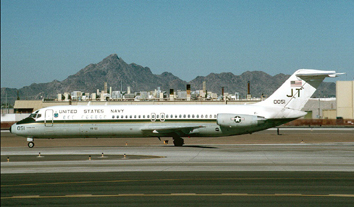
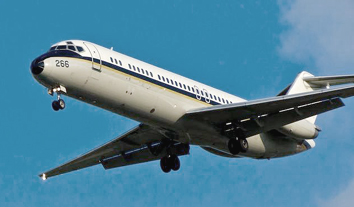
After selecting a modified DC-9 for passenger and cargo transport, the U.S. Navy ordered its first eight aircraft in 1973. An additional six aircraft were delivered to the Navy and the Marine Corps in 1976,An additional ten more new and ten used DC-9s were purchased and converted to C-9B for the Navy. The last C-9B to fly for the Navy was retired on 28 June 2014.
Many of the Navy's C-9Bs had
a higher maximum gross take-off weight of 50,000 kg. Auxiliary fuel
tanks were installed in the lower cargo hold to augment the aircraft's
range to nearly 4,800 km for overseas missions, along with the addition
of tail mounted infrared scramblers to counter heat seeking missile
threats in hostile environments
Nachdem die U.S. Navy eine
modifizierte DC-9 für den Personen- und Frachttransport ausgewählt hatte,
bestellte sie 1973 ihre ersten acht Flugzeuge. Weitere sechs Flugzeuge
wurden 1976 an die Navy und das Marine Corps geliefert, weitere zehn neue
und zehn gebrauchte DC- 9s wurden gekauft und für die Marine zu C-9B
umgebaut. Die letzte C-9B, die für die Marine flog, wurde am 28. Juni 2014
ausgemustert.
Viele der C-9B der Navy hatten ein höheres maxi-males Bruttostartgewicht von
50.000 kg. Zusätz-liche Treibstofftanks wurden im unteren Frachtraum
installiert, um die Reichweite des Flugzeugs für Überseemissionen auf fast
4.800 km zu erhöhen, zusammen mit dem Hinzufügen von am Heck montierten
Infrarot-Scramblern, um Bedrohungen durch wärmesuchende Raketen in
feindlichen Umgebungen entgegenzuwirken
Zeichnungen

VR-1 (1975)
VR-1 (1976)
VR-1 (1978)
VR-30
VR-51
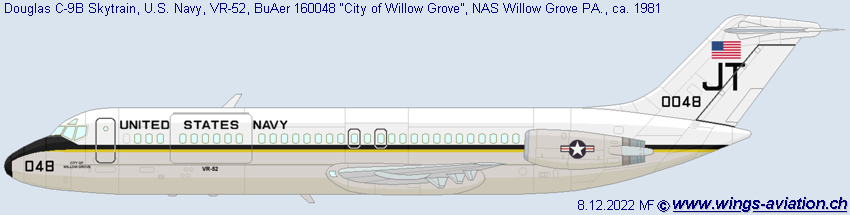
VR-52 (1981)
VR-55
VR-56
VR-57
VR-58
VR-59
VR-60
VR-61
VR-62
159114
159115
159116
159117 VR-1 City of Norfolk
159118 VR-1 City of Jacksonville
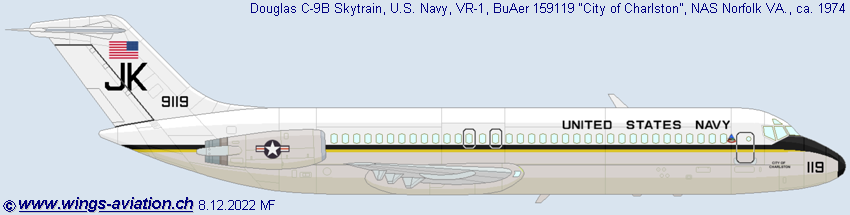
159119 VR-1 City of Charleston
159120 VR-1 City of Virginia
160046
160047
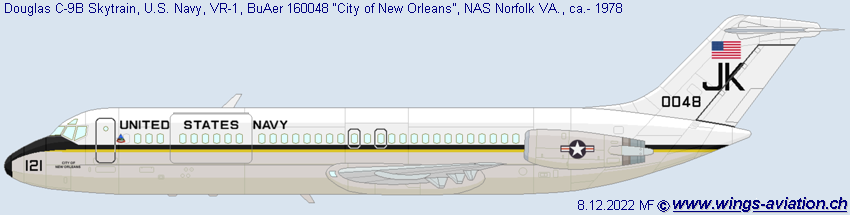
160048 VR-1 City of New Orleans, VR-52 City of Willow Grove
160049
160050
160051
| Specifications |
C-9B Skytrain II |
|
|
Wingspan |
Spannweite |
28.47 m |
|
Length |
Länge |
36.35 m |
|
Height |
Höhe |
8.38 m |
|
Wing area |
Flügelfläche |
93.00 m2 |
|
Engine |
Motor |
2 × Pratt & Whitney JT8D-9 turbofan engines, 14,500 lbf thrust each |
|
Maximum speed |
Höchstgeschwindigkeit |
930 km/h |
|
Empty weight |
Leergewicht |
27,079 kg |
|
Loaded weight |
Startgewicht |
49,895 kg |
|
Climb Rate |
Steigrate |
15 m/s |
|
Service ceiling |
Gipfelhöhe |
11,000 m |
|
Range |
Reichweite |
4,670 km |
|
Armament |
Bewaffnung |
none |
| Capacity | Zuladung |
Crew 5 to 8, 76 pax |
| Serial, Douglas C-9 Skytrain II | ||
|
C-9B |
159030 - 159034 |
cancelled |
|
C-9B |
159113 - 159120 |
8 |
|
C-9B |
160046 - 160052 |
7 |
|
C-9B |
161266 |
1 |
|
C-9B |
161529 - 161530 |
2 |
|
C-9B (DC-9-31) |
162390 - 162393 |
4 |
|
C-9B (DC-9-33) |
162753 - 162754 |
2 |
|
C-9B |
163036 - 163037 |
2 |
|
C-9B |
163208 |
1 |
|
C-9B |
163511 - 163513 |
4 |
|
C-9B |
164605 - 164608 |
4 |
|
NC-9D |
168277 |
1 |
|
Total |
34 |
|
