From the Phantom to the Banshee
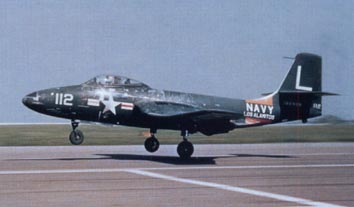
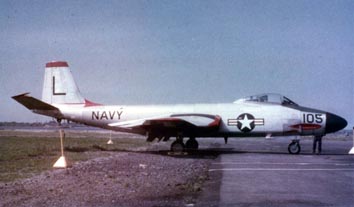
The history of the Mc Donnell F2H- Banshee began on 2. March 1945. On that day, the U.S. Navy decided to continue the development of the FD-1 Phantom – which had made its maiden flight just one month earlier, on 26 January 1945 – under the Banshee programme. The Phantom was the U.S. Navy’s first dedicated jet fighter, but it soon became clear that the aircraft did not possess the performance the Navy had expected. The range, speed, armament and service ceiling of the new jet fighter were intended to be equal to, or even better than, those of comparable USAAF and USAF fighters.
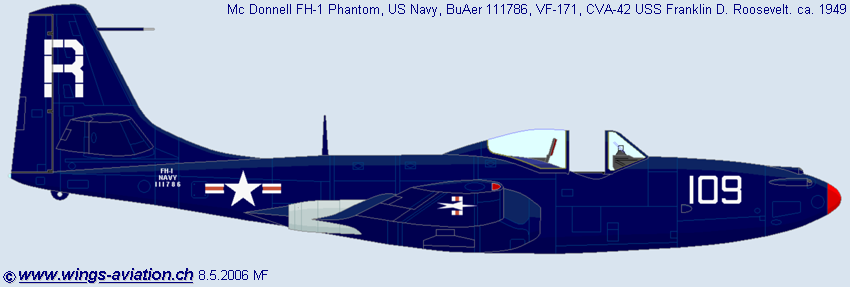
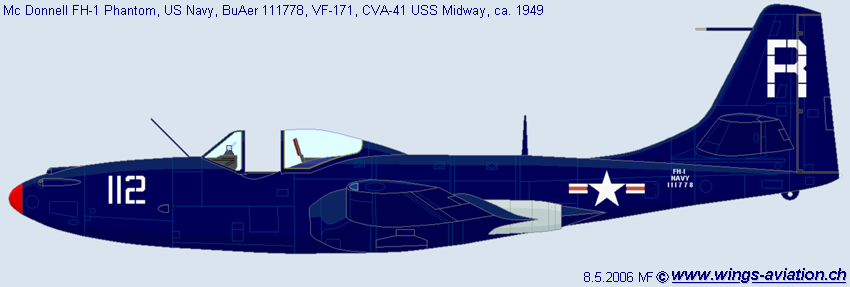
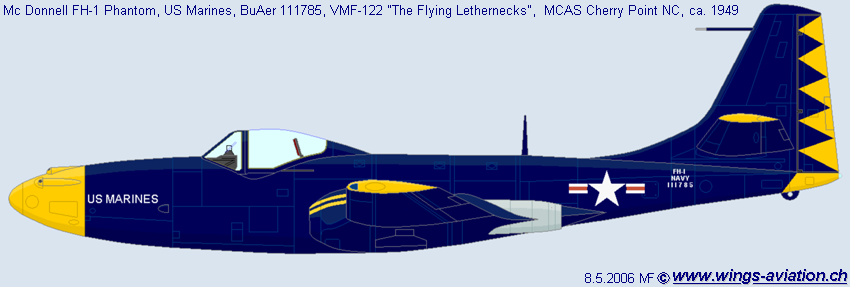
FH-1 Phantom VF-171
The Phantom’s design was retained for the Banshee. McDonnell initially intended to produce an enlarged version of the Phantom, powered by two Westinghouse J34-WE-22 engines, each developing 1,300 Kp of thrust. The armament was to be upgraded from four 12.7 mm machine guns to four 20 mm cannons, each with 150 rounds. However, it very quickly became apparent that this was not feasible. The fuselage and wings had to be completely redesigned.
The wingspan was extended by 25 cm, and the fuselage structure and the design of the air intakes were reinforced. An enlarged and reinforced rudder was fitted. The landing gear was completely redesigned and retracted outwards into the wings. In particular, a so-called ‘kneeling landing gear’ was fitted. The ‘knee landing gear’ was fitted to the nose landing gear doors. The idea was that this would raise the rear of the aircraft, thereby improving the ability to park the aircraft on a carrier. Furthermore, this allowed the hot engine exhaust gases to be deflected upwards. However, the idea did not catch on and later aircraft no longer featured this equipment.
The maiden flight of the XF2D-1 Banshee took place on 11. January 1947 at Lambert Field in St Louis, Missouri. The test pilot was Robert M. Edholm. The maiden flight, which was watched by observers from the U.S. Navy and representatives of McDonnell, was a resounding success. Robert Edholm achieved a rate of climb of 2,743 metres per minute without any problems – a figure twice that of comparable aircraft of the time. However, minor issues in the tail section were identified during the maiden flight and subsequent tests. The problem was rectified by shortening the rudder at its base and removing the angle of attack from the elevator.
In May 1947, the U.S. Navy ordered 56 production aircraft of the F2H-1, as the F2D-1 Banshee was now known. The test programme was carried out by the NATC (Naval Air Test Centre) at Patuxent River, Maryland, and revealed no further problems. Carrier suitability trials were conducted aboard the CVB-42 USS Franklin D. Roosevelt. The production version of the Banshee had a fuel capacity increased by 1,329 litres to 3,320 litres compared with the prototype. This made the Banshee the jet fighter with the largest fuel capacity and greatest range in the U.S. Navy’s inventory.
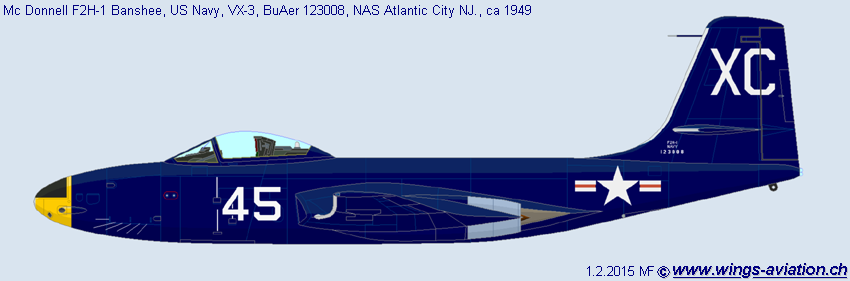
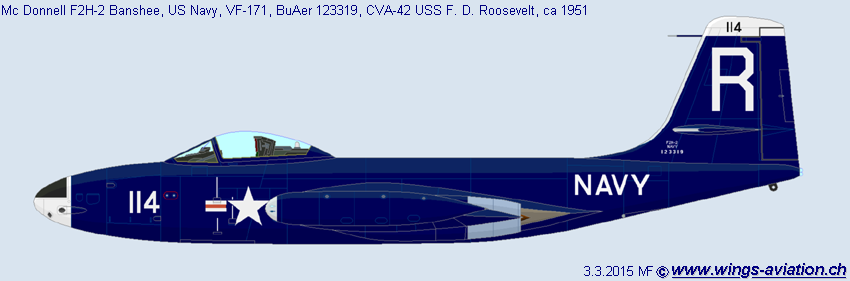
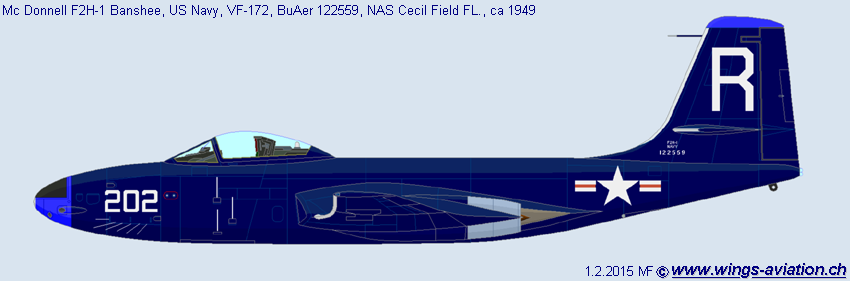
In 1948, 30 F2H-1s were handed over to the US Navy, with the remaining 26 aircraft following in 1949. These aircraft were allocated to the two fighter squadrons of CVG-17, VF-171 and VF-172, at NAS Cecil Field, Florida. A few were assigned to the test squadron VX-3 at NAS Atlantic City, New Jersey. The F2H-1 was powered by the Westinghouse J34-WE-22 engine, producing 1,300 Kp of thrust; this was replaced after a short time by the J34-WE-30, producing 1,361 Kp of thrust.
When the F2H-1 went into production at McDonnell’s, the development department had already begun work on improving the Banshee. Then, in June 1948, the US Navy requested an improved variant of the Banshee. McDonnell’s engineers lengthened the Banshee by 35.6 cm, thereby increasing its fuel capacity by 670 Liter. The wings were reinforced so that a 760 Liter auxiliary fuel tank could be carried at each wingtip. To compensate for the increased weight, the F2H-2 was fitted with the more powerful Westinghouse J34-WE-34 engines, delivering 1,433 kp of thrust.
The F2H-2 also offered a number of advantages over its predecessor in terms of armament. The payload, distributed across four weapon stations, amounted to around 910 kg. Two weapon stations were designed to carry 250 kg of bombs, whilst the remaining stations could each carry a payload of 120 kg.
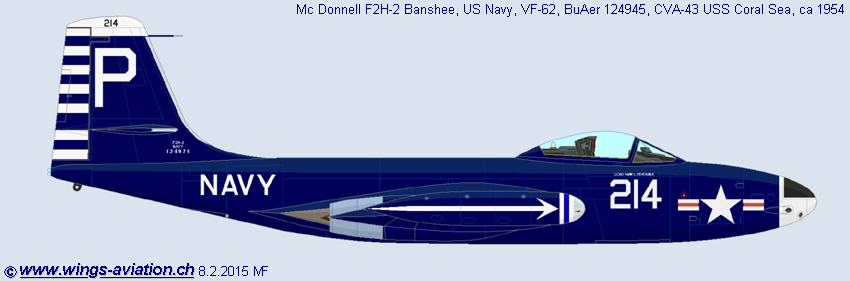
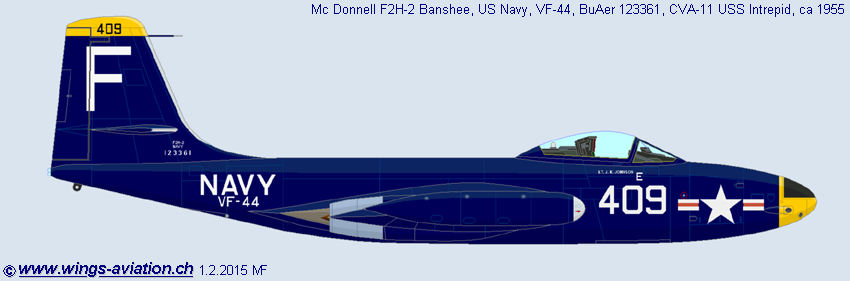
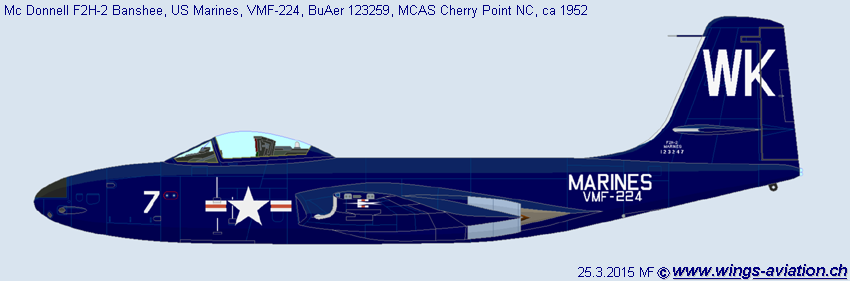
The maiden flight of the F2H-2 Banshee took place on 18 August 1949. The test flight proceeded without any major problems. The U.S. Navy ordered 179 F2H-2 Banshees in August 1948. A further 279 aircraft were ordered in 1949. A total of 408 F2H-2s were produced. Some of the F2H-2s also found their way to the U.S. Marine Corps.
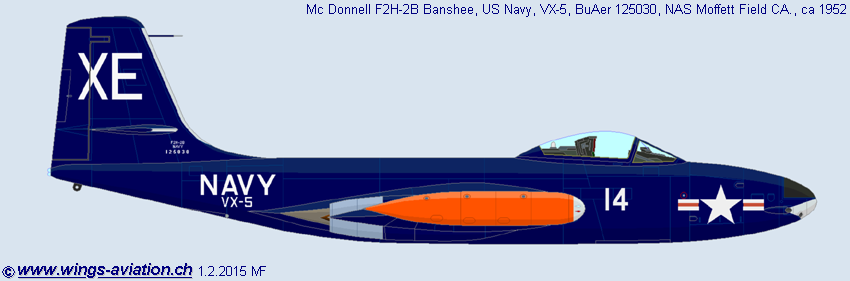
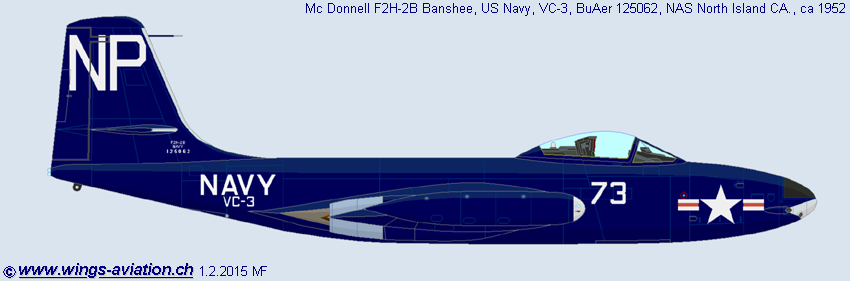
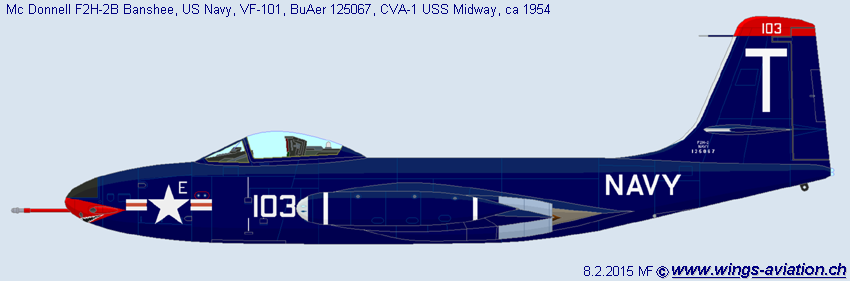
Three specialised variants were developed based on the F2H-2: the F2H-2N, a radar-equipped night fighter fitted with the AN/APS-19 radar; the F2H-2P, a photographic reconnaissance aircraft with six camera stations; and the F2H-2B, an improved fighter-bomber with increased payload capacity.
To meet the U.S. Navy’s requirements for a tactical nuclear bomber, McDonnell developed the F2H-2B with reinforced wings and an increased payload of 1,360 kg. The F2H-2B was capable of carrying Mk. 7 (748.5 kg) or Mk. 8 (1,465.1 kg) nuclear weapons. Only 27 F2H-2Bs were produced. As the clearance between the nuclear weapon and the mounting was too small, the landing gear had to be fitted with stiffer struts. This made landing on an aircraft carrier whilst carrying a nuclear weapon virtually impossible. Furthermore, the F2H-2B featured a pilot-activated aileron force multiplier. This was necessary to control left-hand roll when carrying a heavy nuclear bomb. One cannon was removed to make room for the electronics required to arm the weapon.
Die Staffel VX-5 sowie die Staffeln VC-3 und VC-4 erhielten diese verbesserten Banshee. Im Rahmen von Detachementen dieser Staffeln wurden die F2H-2B von einigen Trägern eingesetzt. Äusserlich sind die F2H-2B von "normalen" F2H-2 nicht zu unterscheiden.
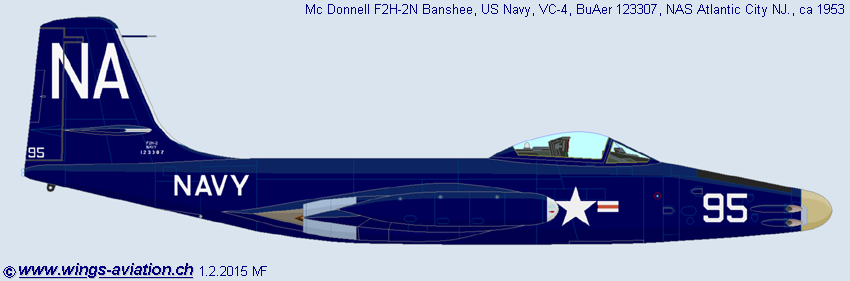
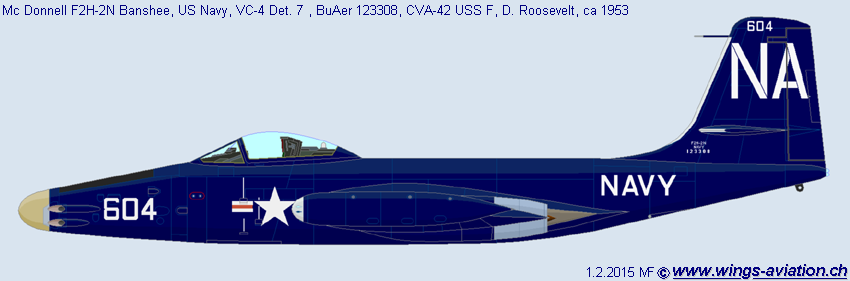
Mc Donnell began work on developing a night-fighter variant equipped with radar at an early stage. The AN/APS-19 radar from the Sperry Corporation was selected. To make room for the radar, the nose of the Banshee was extended by 85.3 cm and the four 20 mm cannons were positioned on the sides. This arrangement of the cannons later proved problematic, as the radar was shaken violently during bursts of fire and became inoperable. A further negative effect was that the extension of the aircraft’s nose reduced its maximum speed; the same effect was observed on the F2H-2P.
Aircraft BuAer 123300 made its maiden flight on 3 February 1950. The F2H-2N was intended merely as a stopgap until a version equipped with a more powerful radar became available. For this reason, only 14 aircraft were built, which were operated by VC-4. The squadron took part in several carrier operations with detachments of three to four aircraft each. The aircraft did not see combat in Korea.
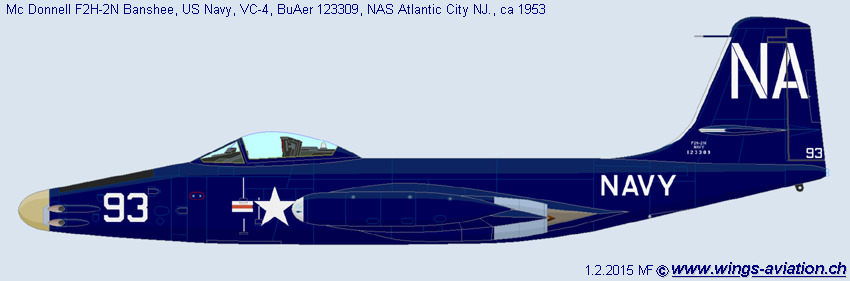
One of the best-known variants of the Banshee is the photographic reconnaissance aircraft, the F2H-2P. The F2H-2’s excellent range and service ceiling made the Banshee ideally suited to the role of reconnaissance aircraft. The US Navy commissioned McDonnell to develop a reconnaissance aircraft with six camera stations based on the F2H-2. Serial number 123336 was fitted with a nose extended by around 70 cm as a prototype. The maiden flight of the F2H-2P took place on 12 October 1950. The modified nose had a negative impact on the aircraft’s flight characteristics only in terms of speed. The maximum speed fell from 920 km/h to 850 km/h. The F2H-2P was fitted with six camera stations; the cameras could be adjusted in flight from the cockpit using a remote control. At the underwing stations, the F2H-2P could carry two containers, each holding 20 flash cartridges, for night-time photography. The Banshee’s armament was completely removed; the reconnaissance pilots could rely solely on their speed.
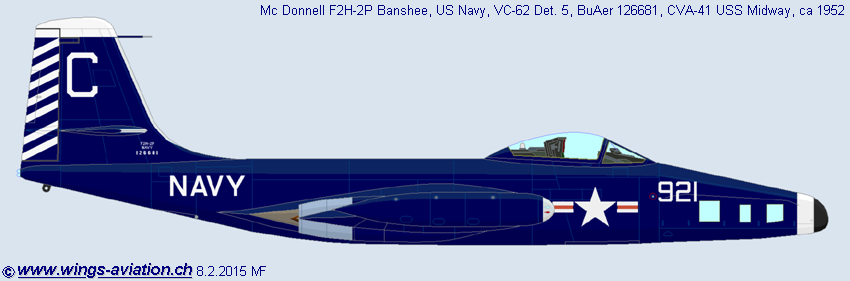
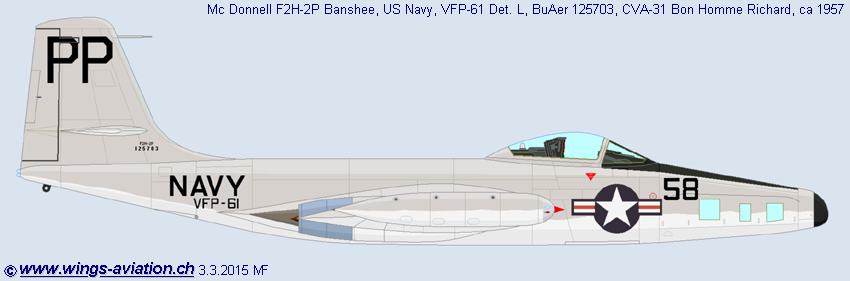
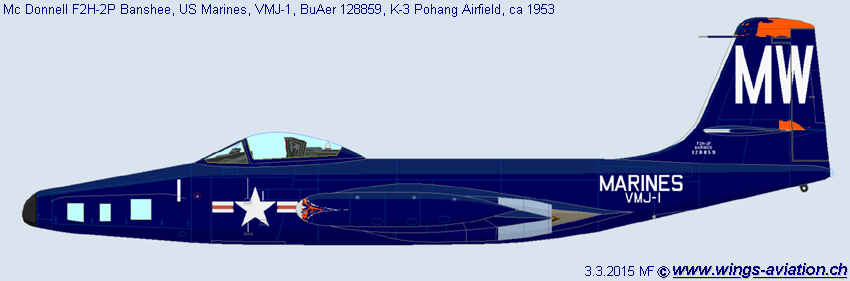
The U.S. Navy and the U.S. Marine Corps ordered a total of 89 reconnaissance aircraft. They were operated by the US Navy squadrons VFP-61 (West Coast) and VFP-62 (East Coast), as well as the US Marine Corps squadrons VMJ-1, -2 and -3. The last F2H-2Ps were not withdrawn from service until 1961.
The F2H-3 was an all-weather fighter equipped with a larger-diameter Westinghouse AN/APQ-41 radar. It represented a complete redesign of the Banshee, as the wing area had also been slightly modified.
The fuselage, which was extended by 2.44 metres, had a fuel capacity increased by over 50 per cent to 4,170 litres. This allowed the removable wingtip tanks to be reduced to 640 litres each, and due to the increased internal capacity, these were now rarely required. The cannons were moved rearwards, away from the nose, to make room for the larger-diameter radar and, at the same time, to allow for increased ammunition capacity. The horizontal stabilisers were lowered from the tail fin to the fuselage and given a V-shape, and on all aircraft except the first, large triangular fillets were fitted to the leading edges.
The F2H-3 could also be fitted for in-flight refuelling. For this purpose, an in-flight refuelling probe, fitted as required, replaced the upper port-side cannon. The maiden flight took place on 29 March 1952, and 250 aircraft were built.
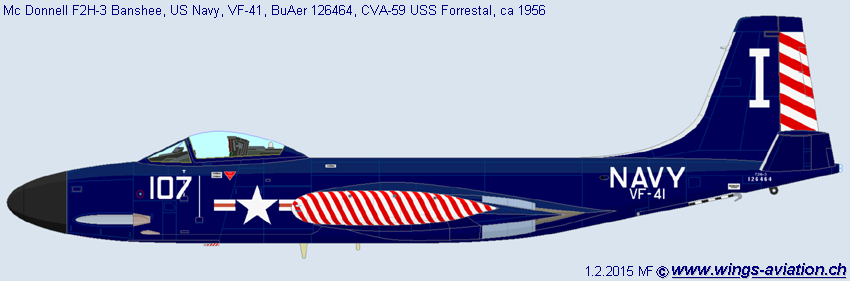
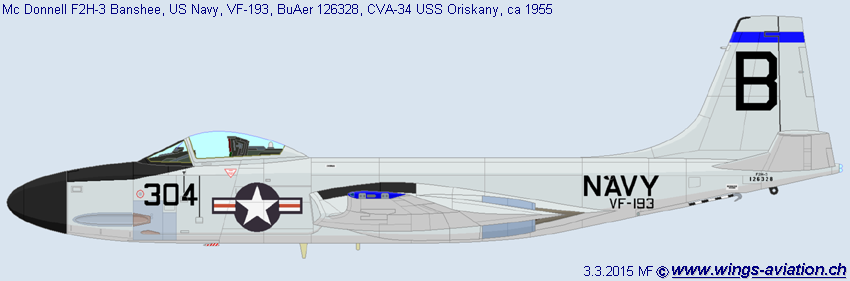
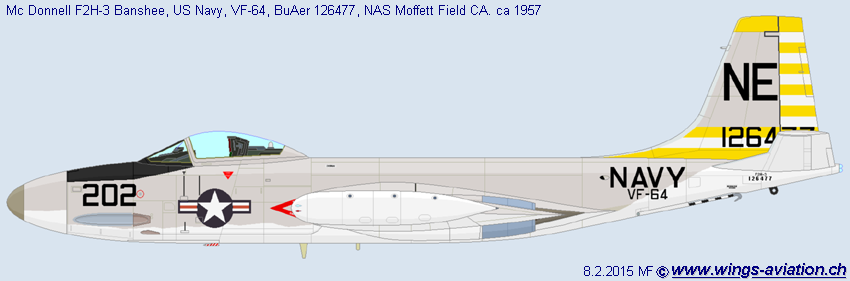
The F2H-4 was a slight improvement on the F2H-3. It was fitted with the more powerful Westinghouse J34-WE-38 engine, which now enabled a top speed of 981 km/h. The service ceiling was now 17,070 m, and the range had been increased by 480 km to 3,220 km. The second innovation concerned the radar; the F2H-4 was fitted with the Hughes AN/APG-37 radar.
The F2H-3 and F2H-4 were flown by several squadrons of the U.S. Navy and the U.S. Marine Corps. Their period of service coincided precisely with the introduction of the Navy’s new grey-and-white camouflage scheme. A few aircraft were left in their natural aluminium finish on an experimental basis. However, this proved unsuitable for use on aircraft carriers, partly due to corrosion. Both types were deployed together within the squadrons. Externally, the aircraft were indistinguishable.
Following the Korean War, the U.S. Navy deployed the radar-equipped F2H-3 and F2H-4 for all-weather fleet defence as a stopgap measure until the McDonnell F3H- Demon, with swept-back wings, and the Douglas F4D- Skyray, with delta wings, were operational.
| Specifications | F2H-2 | F2H-3 | |
|
Wingspan |
Spannweite |
13,50 m |
13,50 m |
|
Length |
Länge |
12,00m |
14,30m |
|
Height |
Höhe |
4,35 m |
4,35 m |
|
Wing area |
Flügelfläche |
|
27.31 m² |
|
Engine |
Motor |
J34-WE-34 1433 kp |
J34-WE-38 1630 kp |
|
Maximum speed |
Höchstgeschwindigkeit |
920 km/h |
960 km/h |
|
Empty weight |
Leergewicht |
? |
5'980 kg |
|
Loaded weight |
Startgewicht |
9'340 kg |
8'700 kg |
|
Climb Rate |
Steigrate |
2743 m/min |
? |
|
Service ceiling |
Gipfelhöhe |
13440 m |
13980 rn |
|
Range |
Reichweite |
2360 km |
3220 km |
|
Armament |
Bewaffnung |
4x20 mm 910 kg |
4x20 mm 1814 kg |

Naval Fighter No.3
Steve Ginter
English
Naval Fighter Series
ISBN: - none -
Book ID 0003

Naval Fighter No.113
Steve Ginter
English
Naval Fighter Series
ISBN: 978-0-942612-53-0
Book ID 1169.

Naval Fighter No.2
Steve Ginter
English
Naval Fighter Series
ISBN: - none -
Book ID 0002

In Action Series No. 182
Jim Mesko
English
Squadron Signal Publications
ISBN: 0-89747-444-9
Book ID 0244

Early Banshees
Naval Fighter No. 73
Steve Ginter
English
Naval Fighters Series
ISBN: 0-942612-73-6
BookID 0071

Big Banshees
Naval Fighter No. 91
Steve Ginter
English
Naval Fighters Series
ISBN: 0-9846114-4-7
BookID 008
Note:
This article was first published on 22 July 2004 on www.wings-aviataion.ch (then
known as www.wings.de.ms) and was partially revised on 20 April 2026.


