Aero L-60 Brigadier
Military Aircraft of the World
Entwicklung
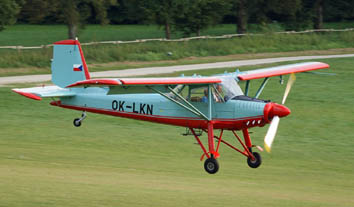
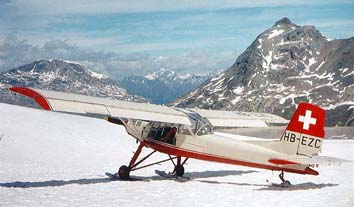
The Aero L-60 Brigadier was a small, high-wing propeller-driven Czechoslovak STOL utility aircraft developed for both civil and military use. A prototype, designated XL-60, with Argus As 10C engine, first flew on December 24, 1953, but it was not successful. The plane was thoroughly redesigned and the second improved prototype, with M-208B flat-six engine, flew on June 8, 1954. The aircraft's configuration bears a strong resemblance to the Fieseler Fi.156 "Storch" licence-produced in Czechoslovakia By the end of production in 1960, 273 had been built by Aero, including an improved version, the L-160 with an all-metal tail.
The L-60 was a braced shoulder wing aircraft with an all-metal monocoque
construction; only the tailplane rudders and the wing between the two
spars were fabric-covered. The trapezoidal wing had slats across its
entire span and slotted flaps that were linked together. It was
connected to both the fuselage and the rigid main landing gear by struts.
The tailplane consisted of a metal structure with an in-flight
adjustable horizontal stabiliser.
Aircraft retrofitted with a Ivchenko AI-14R radial engine are known as
the L-60S.
Die Aero L-60 Brigadier war ein kleiner tschechoslowakischer, propellergetriebens STOL-Mehrzweckflugzeug, das sowohl für den zivilen als auch für den militärischen Einsatz entwickelt wurde. Ein Prototyp mit der Bezeichnung XL-60 und einem Argus As 10C-Motor flog erstmals am 24. Dezember 1953, war jedoch nicht erfolgreich. Das Flugzeug wurde grundlegend überarbeitet, und der zweite verbesserte Prototyp mit einem M-208B-Sechszylinder-Boxermotor flog am 8. Juni 1954. Die Konfiguration des Flugzeugs weist eine starke Ähnlichkeit mit der Fieseler Fi.156 „Storch“ auf, die in der Tschechoslowakei in Lizenz produziert wurde. Bis zum Ende der Produktion im Jahr 1960 wurden von Aero 273 Exemplare gebaut, darunter eine verbesserte Version, die L-160 mit einem Ganzmetallheck.
Die L-60 war ein angestrebter Schulterdecker in Ganzmetall-Schalenbauweise, nur die Ruder des Leitwerks und die Tragfläche zwischen den beiden Holmen waren stoffbespannt. Die trapezförmige Tragfläche hatte Vorflügel über die gesamte Spannweite und Spaltlandeklappen, die miteinander gekoppelt waren. Sie war mit Streben sowohl mit dem Rumpf als auch mit dem starren Hauptfahrwerk verbunden. Das Leitwerk bestand aus einer Metallkonstruktion mit im Flug verstellbarer Höhenflosse.
Flugzeuge, die mit einem Ivchenko AI-14R-Stern-motor nachgerüstet wurden, sind als L-60S bekannt.
Versionen
XL-60
Prototype
XL-60
Prototyp
L-60
Single-engined light utility transport, observation aircraft.
L-60
Einmotoriges leichtes Transport- und Beobachtungsflugzeug.
L-60A
50 production aircraft for the Czech Air Force. Also known as the K-60. Armed with 7.92 mm machine gun in a rear cab.
L-60A
50 Serienflugzeuge für die tschechische Luftwaffe. Auch bekannt als K-60. Bewaffnet mit einem 7,92-mm-Maschinengewehr im hinteren Cockpit.
L-60B
Agricultural crop spraying aircraft (300 L chemicals tank).
L-60B
Flugzeug zum Besprühen von landwirtschaftlichen Kulturen (300-Liter-Chemikalientank).
L-60D
Glider tug aircraft.
L-60D
Segelflugzeugschlepper.
L-60E
Air ambulance aircraft
L-60E
Luftrettungsflugzeug.
L-60F
Glider tug aircraft
L-60F
Segelflugzeugschlepper.
L-60S
Aircraft fitted with a 260-hp Ivchenko AI-14R radial piston engine.
L-60S
Flugzeug mit einem 260 PS starken Ivchenko AI-14R-Sternmotor.
L-60SF
Fitted with the M-462RF radial piston engine.
L-60SF
Ausgestattet mit dem M-462RF-Sternmotor.
L-160
Improved version with all-metal tail.
L-160
Verbesserte Version mit Ganzmetallheck.
Profiles
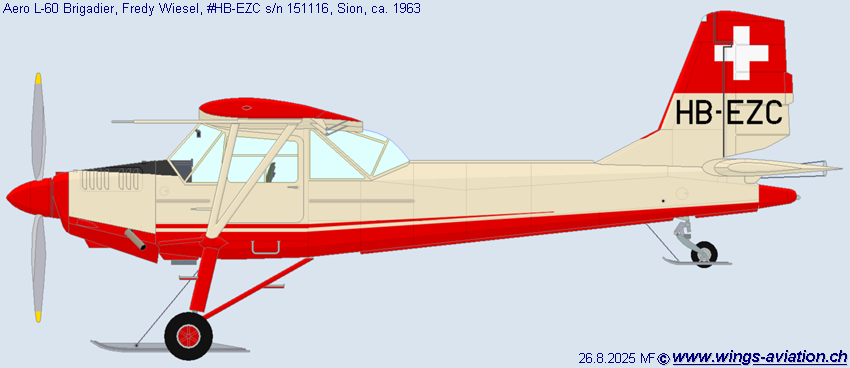
Profile

Nationale Volksarmee
Privat, Fredy Wiesel
| Specifications | L-60 | |
|
Wingspan |
Spannweite |
13.96 m |
|
Length |
Länge |
8.54 m |
|
Height |
Höhe |
2.72 m |
| Wing area | Flügelfläche |
24.30 m2 |
|
Engine |
Motor |
1 × Praga Doris M 208-B air-cooled flat-six engine, 190 hp |
|
Maximum speed |
Höchstgeschwindigkeit |
193 km/h |
|
Empty weight |
Leergewicht |
968 kg |
|
Loaded weight |
Startgewicht |
1,560 kg |
|
Climb Rate |
Steigrate |
? |
|
Service ceiling |
Gipfelhöhe |
4,200 m |
|
Range |
Reichweite |
720 km |
|
Armament |
Bewaffnung |
none |
|
Capacity |
Zuladung |
1 pilot, 3 passengers |
|
Text: |
- |
|
Drawings: |
Michael E. Fader |