Antonov An-14 Ptschjolka
Aircraft of the World
Entwicklung
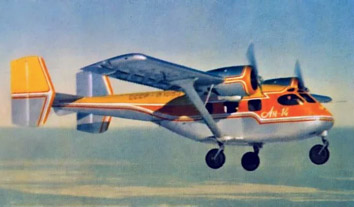
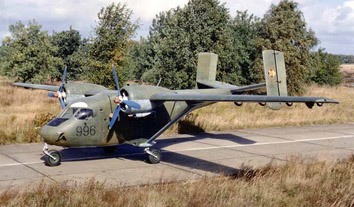
The Antonov An-14 Ptschjolka
"Little Bee" is a Soviet utility aircraft which was first flown on 15.
March 1958. It was a twin-engined light STOL utility transport, with two
300 hp Ivchenko AI-14RF radial piston engines. Serial production started
in 1966, and about 300 examples were built by the time production ended
in 1972. The An-14 failed to replace the more successful An-2 biplane,
which was manufactured until 2001. The An-14's successor, the An-28 with
turboprop engines, is still manufactured under the names PZL M28
Skytruck.
The development goal was an aircraft that was easy to fly and could be
used as a light passenger and cargo transport aircraft as well as an
agricultural aircraft and air rescue aircraft. The maiden flight took
place on 15 March 1958. The An-14 was a high-wing aircraft with struts,
powered by two air-cooled nine-cylinder Ivchenko AI-14 radial engines.
The strut-braced wing has automatic slats and split flaps. Two vertical
stabilisers are attached to the ends of the tailplane, which is located
in the airflow of the propellers. The tricycle landing gear was not
retractable in the original version, but could be equipped with skis for
winter use. Short floats are used to attach the main landing gear. The
fuselage is an all-metal semi-monocoque construction. Thanks to its very
stable flight characteristics, most pilots were able to fly the An-14
after just a few hours of basic training. A small number of An-14s are
still airworthy.
Die Antonow An-14 Ptschjolka
„Bienchen“ ist ein sowjetisches Transportflugzeug, das am 15. März 1958
seinen Erstflug absolvierte. Es handelte sich um ein zweimotoriges leichtes
STOL-Transport-flugzeug mit zwei 300 PS starken Ivchenko
AI-14RF-Sternmotoren. Die Serienproduktion begann 1966, und bis zum Ende der
Produktion im Jahr 1972 wurden etwa 300 Exemplare gebaut. Die An-14 konnte
die erfolgreichere Doppeldecker An-2, die bis 2001 hergestellt wurde, nicht
ersetzen. Der Nachfolger der An-14, die An-28 mit Turboprop-Motoren, wird
noch immer unter dem Namen PZL M28 Skytruck hergestellt.
Das Entwicklungsziel war ein Flugzeug, das leicht zu fliegen war und sowohl
als leichtes Passagier- und Frachttransportflugzeug als auch als
Agrarflugzeug und Luftrettungsflugzeug eingesetzt werden konnte. Der
Jungfernflug fand am 15. März 1958. Die An-14 war ein Hochdecker mit
Streben, der von zwei luftgekühlten Neunzylinder-Stern-motoren vom Typ
Ivchenko AI-14 angetrieben wurde. Der mit Streben versehene Flügel verfügt
über automatische Vorflügel und geteilte Klappen. An den Spitzen des
Leitwerks sind zwei vertikale Stabilisatoren angebracht, die im Luftstrom
der Propeller liegen. Das Dreiradfahrwerk war in der ursprünglichen Variante
nicht einziehbar, konnte aber für den Wintereinsatz mit Skiern ausgestattet
werden. Kurze Schwimmer dienen zur Befestigung des Hauptfahrwerks. Der Rumpf
ist eine Ganzmetall-Halbschalenkonstruktion. Dank ihrer sehr stabilen
Flugeigenschaften konnte die An-14 von den meisten Piloten nach nur wenigen
Stunden Grundausbildung geflogen werden. Eine kleine Anzahl von An-14 ist
noch immer flugtauglich.
Versionen
An-14
Prototypes with 240 hp Ivchenko AI-14R engines and a rectangular wing. 2 built
An-14
Prototypen mit 240 PS starken Iwtschenko AI-14R Motoren und einem rechteckigen Flügel. 2 gebaut
An-14A
Production version with improved wings and a tail design featuring a pronounced V-shape of the horizontal stabiliser and a modified shape of the vertical stabiliser.
An-14A
Serienversion mit verbesserten Tragflächen sowie ein Leitwerk mit deutlicher V-Form des Höhenleit-werkes und geänderter Form des Seitenleitwerkes.
An-14B
A modified version. It featured improved aerodynamics, a V-shaped tail and no wing struts, and had a single-wheel landing gear.
An-14B
Eine modifizierte Version. Sie zeichnete sich durch verbesserte Aerodynamik, ein V-förmiges Leitwerk und den Verzicht auf eine Flügelver-strebung und mit Einzeihfahrwerk.
An-14B
The military version was often used for reconnaissance and liaison tasks.
An-14B
Die militärische Version wurde oft für Aufklärungs- und Verbindungsaufgaben verwendet.
An-14Sh
Test version with an air cushion landing gear for unpaved runways.
An-14Sh
Testversion mit einem Luftkissenfahrwerk für unbefestigte Landebahnen.
An-14M
A modernised prototype (later An-28). It had GTD-550AS engines, an extended fuselage, a modified wing design, a door on the left side, a semi-retractable landing gear and a different tail unit. Only one prototype was built.
An-14M
Ein modernisierter Prototyp (Später An-28). Er verfügte über GTD-550AS-Triebwerke, einen verlängerten Rumpf, eine geänderte Flügelkonstruktion, eine Tür auf der linken Seite, ein halb einziehbares Fahrwerk und ein ande-res Leitwerk. Es wurde ein einziger Prototyp gebaut.
Profiles
Profile


Nationale Volksarmee
Nationale Volksarmee
Nationale Volksarmee


Nationale Volksarmee
Nationale Volksarmee
Nationale Volksarmee
| Specifications | An-14A | |
|
Wingspan |
Spannweite |
21.99 m |
|
Length |
Länge |
11.36 m |
|
Height |
Höhe |
4.63 m |
| Wing area | Flügelfläche |
39.72 m2 |
|
Engine |
Motor |
2 × Ivchenko AI-14RF 9-cylinder air-cooled radial piston engines, 300 hp each |
|
Maximum speed |
Höchstgeschwindigkeit |
210 km/h |
|
Empty weight |
Leergewicht |
2,600 kg |
|
Loaded weight |
Startgewicht |
3,600 kg |
|
Climb Rate |
Steigrate |
? |
|
Service ceiling |
Gipfelhöhe |
5,000 m |
|
Range |
Reichweite |
650 km |
|
Armament |
Bewaffnung |
none |
|
Capacity |
Zuladung |
6-8 passengers / 720 kg payload |
|
Text: |
- |
|
Drawings: |
Michael E. Fader |