|
|
|
|
|
|
|
|
|
. |
|
Grumman G-79
Panther |
. |
|
Military Aircraft of
the World |
. |
|
|
|
|
|
|
|
|
|
. |
|
 |
 |
| |
|
|
|
|
|
|
|
|
. |
|
Development |
|
Entwicklung |
|
|
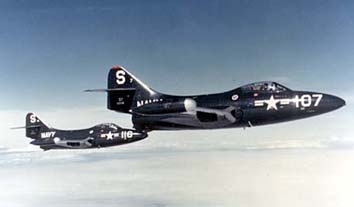
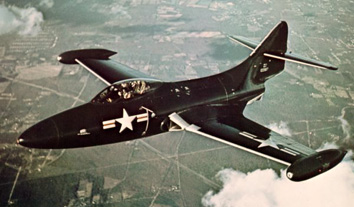
The Grumman F9F- Panther is
an early carrier-based jet fighter designed and produced by the aircraft
manufacturer Grumman. Development of the Panther commenced in the final
months of World War II to harness the recent innovation of the jet
engine. Grumman designed a single-engined, straight-winged day fighter
that was armed with four 20 mm cannons and could also carry a wide
assortment of air-to-ground munitions. Production aircraft were
typically powered by a single Allison J33 or Pratt & Whitney J48-P-2
turbojet engine.
At that time, the few American engines that were available for use, such
as the Allison J33 and Westinghouse J34, were not considered to be
sufficiently reliable; thus, the Navy specified the imported Rolls-Royce
Nene turbojet, which was also more powerful, at 5,000 lbf of thrust.
Production aircraft were to also be powered by the Nene, built under
license by Pratt & Whitney as the J42. Since there was insufficient
space within the wings and fuselage to provide sufficient fuel for the
thirsty jet engine, the design team opted to add permanently mounted
wingtip fuel tanks, which had the incidental advantage of improving the
fighter's rate of roll. The wings featured another innovation in the
form of leading edge flaps that generated additional lift while landing;
speed brakes were also present on the underside of the fuselage.
On 21. November 1947, the prototype performed its maiden flight, powered
by an imported Rolls-Royce Nene engine. During September 1949, the F9F-
was cleared for flight from aircraft carriers. A total of 1,385 Grumman
Panthers were produced.
|
|
Die Grumman F9F- Panther ist ein
frühes Träger-basiertes Düsenjagdflugzeug, das vom Flugzeug-hersteller
Grumman entwickelt und produziert wurde. Die Entwicklung der Panther begann
in den letzten Monaten des Zweiten Weltkriegs, um die jüngsten Innovationen
im Bereich der Düsentrieb-werke zu nutzen. Grumman entwarf ein einmotor-iges
Tagesjagdflugzeug mit geraden Tragflächen, das mit vier 20-mm-Kanonen
bewaffnet war und auch eine große Auswahl an Luft-Boden-Munition
transportieren konnte. Die Serienflugzeuge wurden in der Regel von einem
einzigen Allison J33- oder Pratt & Whitney J48-P-2-Turbostrahltriebwerk
angetrieben.
Zu dieser Zeit galten die wenigen verfügbaren amerikanischen Triebwerke wie
das Allison J33 und das Westinghouse J34 als nicht ausreichend zuverlässig.
Daher entschied sich die Marine für das importierte Rolls-Royce
Nene-Turbostrahl-triebwerk, das mit einer Schubkraft von 5.000 lbf auch
leistungsstärker war. Die Serienflugzeuge sollten ebenfalls mit dem
Nene-Triebwerk ausge-stattet werden, das von Pratt & Whitney unter Lizenz
als J42 gebaut wurde. Da in den Trag-flächen und im Rumpf nicht genügend
Platz für den Treibstoffvorrat des durstigen Strahltriebwerks vorhanden war,
entschied sich das Konstruktions-team für den Einbau fest montierter
Flügelspitzen-Treibstofftanks, die den zusätzlichen Vorteil hatten, die
Rollrate des Jagdflugzeugs zu verbessern. Eine weitere Innovation waren die
Flügel mit Vorflügeln, die bei der Landung für zusätzlichen Auftrieb
sorgten; außerdem waren an der Unterseite des Rumpfes Bremsklappen
angebracht.
Am 21. November 1947 absolvierte der Prototyp seinen Jungfernflug,
angetrieben von einem impor-tierten Rolls-Royce Nene-Triebwerk. Im September
1949 wurde die F9F- für den Flugbetrieb von Flugzeugträgern freigegeben.
Insgesamt wurden 1'385 Grumman Panthers produziert.
|
| |
|
|
|
|
|
|
|
|
. |
|
Variants |
|
Versionen |
|
|
XF9F-2 |
The
first two prototypes |
|
XF9F-2 |
Erste
zwei Prototypen |
|
|
F9F-2 |
First
production version, powered by J42-P-6 engine. 567 build |
|
F9F-2 |
Erste
Version der Panther mit Pratt & Whitney J42-P-6 Triebwerk. 567
Flugzeuge gebaut |
|
|
F9F-2B |
Version
fitted with underwing racks for bombs and rockets. All F9F-2s were
eventually so modified, and the B designation was dropped. |
|
F9F-2B |
Version
mit Waffenrecks für Bomben und Raketen. Alle F9F-2 wurden so modifiziert
und die Bezeichnung wieder aufgegeben. |
|
|
F9F-2P |
Unarmed
photographic reconnaissance version used in Korea. |
|
F9F-2P |
Unbewaffneter
Aufklärer der in Korea eingesetzt wurde. |
|
|
F9F-2KD |
F9F-2s converted into unmanned target drone aircraft. |
|
F9F-2KD |
Umbau
der F9F-2 zur unbemannten Drohne. |
|
|
XF9F-3 |
The
third prototype with Allison
J33-A-8 engine. |
|
XF9F-3 |
Dritter
Prototyp mit Allison J33-A-8 Triebwerk. |
|
|
F9F-3 |
Allison
J33-A-8 powered version produced as insurance against the failure of the
J42, 54 built. All converted to J42 power later. |
|
F9F-3 |
Version
mit einem Allison-Triebwerk J33-A-8, wurden aber wegen Unzuverlässigkeit
des Motors zu F9F-2 umgebaut. 54 Flugzeuge gebaut. |
|
|
XF9F-4 |
Prototype
used in the development of the F9F-4. |
|
XF9F-4 |
Prototyp
für die Entwicklung der F9F-4. |
|
|
F9F-4 |
Version
with longer fuselage with greater fuel load and powered by J33-A-16 engine.
Most re-engined with J48-P-2
engine and completes as F9F-5. 73 planes planed but onyl a few where bulsd
for the Marine Corps. |
|
F9F-4 |
Version
mit einem Allison J33-A-16 Triebwerk mit 3.152 kg Schub und verlängertem
Rumpf. Die meisten F9F-4 wurden wegen Triebwerksschwierigkeiten als F9F-5
fertig gestellt. 73 Flugzeuge geplant, einige wurden für das Marine Corps
fertig gestellt. |
|
|
F9F-5 |
Variant
of F9F-4, but powered by Pratt & Whitney J48-P-2 engine, 616 built. |
|
F9F-5 |
Variante
der F9F-4, aber mit einem Pratt & Whitney-J48-P-2-Triebwerk ausgerüstet.
616 Maschinen gebaut. |
|
|
F9F-5P |
Unarmed
photo-reconnaissance version with longer nose.36 built. |
|
F9F-5P |
Unbewaffneter
Aufklärer mit verlängertem Bug. 36 Flugzeuge gebaut. |
|
|
F9F-5K |
F9F-5s
converted into unmanned target drone aircraft. |
|
F9F-5K |
Umbau
der F9F-5 zur unbemannten Drohne. |
|
|
F9F-5KD |
As
drone directors for the F9F-5K drones. Redesignated DF-9E in 1962. |
|
F9F-5KD |
Umbau
von F9F-5 zu Drohnenkontroll-flugzeugen, nach 1962 als DF-9E bezeichnet |
|
|
|
|
|
|
|
|
|
.. |
|
Profiles |
|
Profile |
|
F9F-2 |
|
|
. |
|
|
 |
 |
 |
| |
U.S. Navy |
U.S. Navy |
U.S. Navy |
|
|
 |
 |
 |
| |
U.S. Navy |
U.S. Navy |
U.S. Navy |
|
|
 |
 |
 |
| |
U.S. Navy |
U.S. Navy |
U.S. Navy |
|
|
 |
 |
 |
| |
U.S. Navy |
U.S. Navy |
U.S. Navy |
|
|
 |
 |
 |
| |
U.S. Navy |
U.S. Navy |
U.S. Navy |
|
|
 |
 |
 |
| |
U.S. Navy |
U.S. Navy |
U.S. Navy |
|
|
 |
 |
 |
| |
U.S. Navy |
U.S. Navy |
U.S. Navy |
|
|
 |
 |
 |
| |
U.S. Navy |
U.S. Navy |
U.S. Navy |
|
|
 |
 |
 |
| |
U.S. Navy |
U.S. Navy |
U.S. Navy |
|
|
 |
 |
 |
| |
U.S. Navy |
U.S. Navy |
U.S. Navy |
|
|
 |
 |
 |
| |
U.S. Navy |
U.S. Navy |
U.S. Navy |
|
|
 |
 |
 |
| |
U.S. Navy |
U.S. Navy |
U.S. Navy |
|
|
 |
 |
 |
| |
U.S. Navy |
U.S. Navy |
U.S. Navy |
|
|
 |
 |
 |
| |
U.S. Navy |
U.S. Navy |
U.S. Navy |
|
|
 |
 |
 |
| |
U.S. Navy |
U.S. Navy |
U.S. Navy |
|
|
 |
 |
 |
| |
U.S. Navy |
U.S. Navy |
U.S. Navy |
|
|
 |
 |
 |
| |
U.S. Navy |
U.S. Navy |
U.S. Marines |
|
|
 |
 |
 |
| |
U.S. Marines |
U.S. Marines |
U.S. Marines |
|
|
 |
 |
 |
| |
U.S. Marines |
U.S. Marines |
U.S. Marines |
|
F9F-2B |
|
|
. |
|
|
 |
 |
 |
| |
U.S. Navy |
U.S. Marines |
U.S. Marines |
|
|
 |
 |
 |
| |
U.S. Marines |
U.S. Marines |
U.S. Marines |
|
|
 |
 |
|
| |
U.S. Marines |
U.S. Marines |
|
|
F9F-2KD |
|
|
. |
|
|
 |
 |
|
| |
U.S. Navy |
U.S. Navy |
|
|
F9F-2P |
|
|
. |
|
|
 |
 |
 |
| |
U.S. Navy |
U.S. Navy |
U.S. Navy |
|
|
 |
 |
 |
| |
U.S. Navy |
U.S. Navy |
U.S. Navy |
|
|
 |
 |
|
| |
U.S. Navy |
U.S. Navy |
|
|
F9F-3 |
|
|
. |
|
|
 |
 |
 |
|
U.S. Navy |
U.S. Navy |
U.S. Navy |
|
F9F-4 |
|
|
. |
|
|
 |
 |
 |
| |
U.S. Marines |
U.S. Marines |
U.S. Marines |
|
|
 |
 |
 |
| |
U.S. Marines |
U.S. Marines |
U.S. Marines |
|
|
 |
|
|
| |
U.S. Marines |
|
|
|
F9F-5 |
|
|
. |
|
|
 |
 |
 |
| |
U.S. Navy |
U.S. Navy |
U.S. Navy |
|
|
 |
 |
 |
| |
U.S. Navy |
U.S. Navy |
U.S. Navy |
|
|
 |
 |
 |
| |
U.S. Navy |
U.S. Navy |
U.S. Navy |
|
|
 |
 |
 |
| |
U.S. Navy |
U.S. Navy |
U.S. Navy |
|
|
 |
 |
 |
| |
U.S. Navy |
U.S. Navy |
U.S. Navy |
|
|
 |
 |
 |
| |
U.S. Navy |
U.S. Navy |
U.S. Navy |
|
|
 |
 |
 |
| |
U.S. Navy |
U.S. Navy |
U.S. Navy |
|
|
 |
 |
 |
| |
U.S. Navy |
U.S. Navy |
U.S. Navy |
|
|
 |
 |
 |
| |
U.S. Navy |
U.S. Navy |
U.S. Navy |
|
|
 |
 |
 |
| |
U.S. Navy |
U.S. Navy |
U.S. Navy |
|
|
 |
 |
 |
| |
U.S. Navy |
U.S. Navy |
U.S. Navy |
|
|
 |
 |
 |
| |
U.S. Navy |
U.S. Navy |
U.S. Navy |
|
|
 |
 |
 |
| |
U.S. Navy |
U.S. Navy |
U.S. Navy |
|
|
 |
 |
 |
| |
U.S. Navy |
U.S. Navy |
U.S. Navy |
|
|
 |
 |
 |
| |
U.S. Navy |
U.S. Navy |
U.S. Navy |
|
|
 |
 |
 |
| |
U.S. Navy |
U.S. Navy |
U.S. Navy |
|
|
 |
 |
 |
| |
U.S. Navy |
U.S. Navy |
U.S. Navy |
|
|
 |
 |
 |
| |
U.S. Navy |
U.S. Navy |
U.S. Navy |
|
|
 |
 |
 |
| |
U.S. Navy |
U.S. Navy |
U.S. Marines |
|
|
 |
 |
 |
| |
U.S. Marines |
U.S. Marines |
U.S. Marines |
|
|
 |
 |
 |
| |
U.S. Marines |
U.S. Marines |
U.S. Marines |
|
|
 |
 |
 |
| |
U.S. Marines |
U.S. Marines |
U.S. Marines |
|
|
 |
 |
 |
| |
U.S. Marines |
U.S. Marines |
U.S. Marines |
|
|
 |
 |
 |
| |
U.S. Marines |
U.S. Marines |
U.S. Marines |
|
|
 |
 |
 |
| |
U.S. Marines |
U.S. Marines |
U.S. Marines |
|
|
 |
 |
 |
| |
U.S. Marines |
U.S. Marines |
U.S. Marines |
|
F9F-5KD later
DF-9E |
|
|
. |
|
|
 |
 |
 |
| |
U.S. Navy |
U.S. Navy |
U.S. Navy |
|
|
 |
|
|
| |
U.S. Navy |
U.S. Navy |
|
|
F9F-5P |
|
|
. |
|
|
 |
 |
 |
| |
U.S. Navy |
U.S. Navy |
U.S. Navy |
|
|
 |
 |
 |
| |
U.S. Navy |
U.S. Marines |
U.S. Marines |
|
|
 |
 |
|
| |
U.S. Marines |
U.S. Marines |
|
|
|
|
|
|
|
|
|
|
. |
| |
| Specifications |
F9F-5 |
|
Wingspan |
Spannweite |
11,80
m |
|
Length |
Länge |
11,50
m |
|
Height |
Höhe |
3,80
m |
|
Wing
area |
Flügelfläche |
23,20
m² |
|
Engine |
Motor |
Pratt
& Whitney J-48-P-6A
2.835
kg Schub |
|
Maximum
speed |
Höchstgeschwindigkeit |
932
km/h |
|
Empty
weight |
Leergewicht |
4.603
kg |
|
Loaded
weight |
Startgewicht |
8.492
kg |
|
Climb
Rate |
Steigrate |
? |
|
Service
ceiling |
Gipfelhöhe |
13'045
m |
|
Range |
Reichweite |
2'092
km |
|
Armament |
Bewaffnung |
4×
20 mm cannon
up to 910
kg of bombs |
|
Capacity |
Zuladung |
1 pilot |
|
|
|
|
|
|
|
|
|
|
|
. |
|
|
|
Text: |
- |
|
Drawings: |
Michael E. Fader |
|
|
|
|
|
|
|
|
|
|
|
. |