Lockheed P-3 Orion
Military Aircraft of the World
Entwicklung
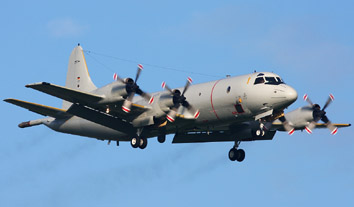
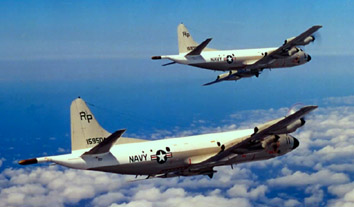
The Lockheed P-3 Orion is a
four-engined, turboprop anti-submarine and maritime surveillance
aircraft developed for the U.S. Navy and introduced in the 1960s.
In August 1957, the U.S. Navy called for proposals for replacement of
the piston-engined Lockheed P2V- Neptune and Martin P5M- Marlin with a
more advanced aircraft to conduct maritime patrol and antisubmarine
warfare. Modifying an existing aircraft should save on cost and to allow
rapid introduction into the fleet. Lockheed suggested a military version
of its L-188 Electra, then still in development and yet to fly. In April
1958, Lockheed won the competition and was awarded an initial
research-and-development contract in May 1958. Lockheed modified the
prototype from the third Electra airframe c/n 1003. The first flight of
the aircraft's aerodynamic prototype, originally designated YP3V-1, took
place on 19. August 1958. While based on the same design philosophy as
the Electra, the aircraft differed structurally; it had 2.1 m less
fuselage forward of the wings with an opening bomb bay, and a more
pointed nose radome, a distinctive tail "stinger" for detection of
submarines by MAD, wing hardpoints, and other internal, external, and
airframe-production technique enhancements.
The first production version was launched on 15 April 1961. Initial
squadron deliveries to VP-8 at NAS Patuxent River, Maryland, began in
August 1962. Until 1990, 757 P-3 Orions were produced in different
variants.
Die Lockheed P-3 Orion ist ein
viermotoriges Turboprop-Flugzeug zur U-Boot-Abwehr und See-überwachung, das
für die US-Marine entwickelt und in den 1960er Jahren eingeführt wurde.
Im August 1957 rief die U.S. Navy zur Einreichung von Vorschlägen auf, um
die kolbengetriebenen Lockheed P2V- Neptune und Martin P5M- Marlin durch ein
moderneres Flugzeug für die See-patrouille und die U-Boot-Bekämpfung zu
ersetzen. Die Modifizierung eines bestehenden Flugzeugs sollte Kosten sparen
und eine schnelle Einführung in die Flotte ermöglichen. Lockheed schlug eine
Militärversion seiner L-188 Electra vor, die sich damals noch in der
Entwicklung befand und noch nicht geflogen war. Im April 1958 gewann
Lockheed den Wettbewerb und erhielt im Mai 1958 einen ersten Forschungs- und
Entwicklungsauftrag. Lockheed modifizierte den Prototyp aus der dritten
Electra-Zelle (c/n 1003). Der Erstflug des aerodynamischen Prototyps, der
ursprünglich als YP3V-1 bezeichnet wurde, fand am 19. August 1958 statt.
Obwohl das Flugzeug auf der gleichen Konstruktionsphilosophie wie die
Electra basierte, unterschied es sich strukturell; es hatte 2,1 m weniger
Rumpf vor den Tragflächen mit einem offenen Bombenschacht und einem
spitzeren Bugradom, einem markanten "Stinger" am Heck zur Erkennung von
U-Booten durch das MAD, Hartpunkten an den Tragflächen und anderen internen
und externen Verbesserungen sowie Verbesserungen bei der Herstellung der
Flugzeug-zelle.
Die erste Serienversion lief am 15. April 1961 vom Band. Die ersten
Auslieferungen an VP-8 in NAS Patuxent River, Maryland, begannen im August
1962. 757 P-3 Orion unterschiedlicher Varianten wurden bis 1990 produziert.
Versionen
The original production version; 157 built.
Die ursprüngliche Produktionsversion; 157 gebaut.
Seven modified for electronic reconnaissance testing.
Three modified for the US Naval Research Laboratory.
Two modified for scientific uses for the former Oceanographic Development Sqn.
12 modified for training duties with all ASW gear removed.
38 reconfigured as utility transports with all the ASW gear removed.
Three WP-3A and two P-3A aircraft converted into VIP/staff transports.
Four converted for weather reconnaissance.
Second main production version with T56-A14 engines
Two P-3A aircraft converted into ELINT aircraft
One P-3B converted into a testbed, for the USN Research Laboratory.
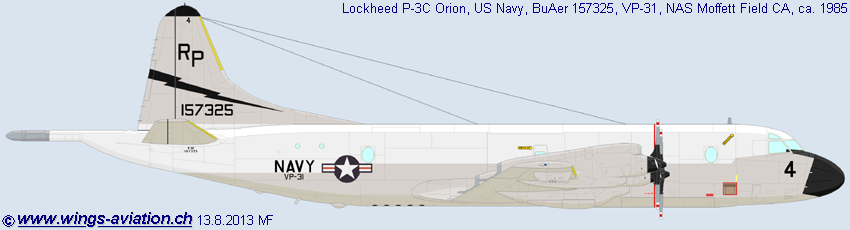
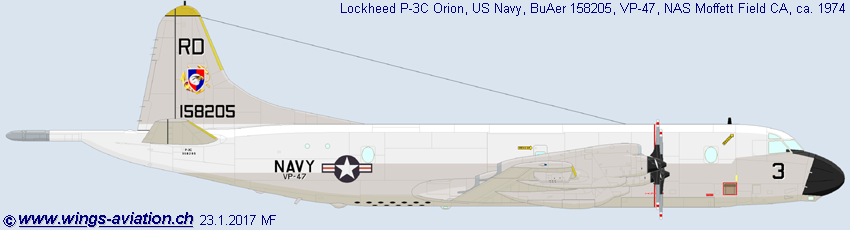
Third main production version with T56-A14 engines. The P-3C had a new ASW suite and mission computer.
Dritte Hauptproduktionsversion mit T56-A14-Triebwerken. Die P-3C erhielt eine neue ASW-Ausrüstung und einen neuen Missionscomputer.
One P-3C converted into a testbed, for the USN Research Laboratory.
One modified for scientific uses
One P-3C modified to optimize MAD capabilities. "Project Magnet".
Production variant of the P-3 Orion used by the National Oceanic and Atmospheric Administration.
10 P-3As, 2 EP-3Bs and 12 P-3Cs converted into ELINT aircraft.
10 P-3A, 2 EP-3B und 12 P-3C wurden zu ELINT-Flugzeugen umgebaut.
Two P-3A aircraft modified for FEWSG use as adversary EW platform
Zwei P-3A-Flugzeuge wurden für den Einsatz der FEWSG als gegnerische EW-Plattform modifiziert.
P-3T
Two former USN P-3Cs modified for the Royal Thai Navy.
P-3T
Zwei ehemalige P-3C der USN, die für die Royal Thai Navy umgebaut wurden.
UP-3T
A single former USN P-3A modified for Royal Thai Navy VIP use and some surveillance operations.
UP-3T
Eine einzelne ehemalige USN P-3A, die für VIP-Einsätze und einige Überwachungseinsätze der Royal Thai Navy umgebaut wurde.
Profiles
Profile
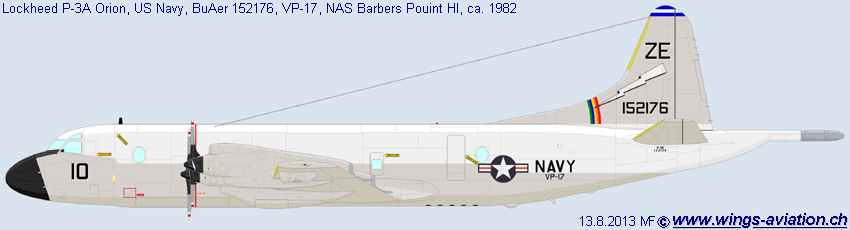
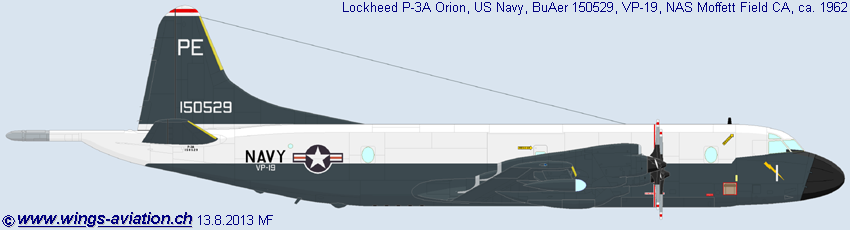
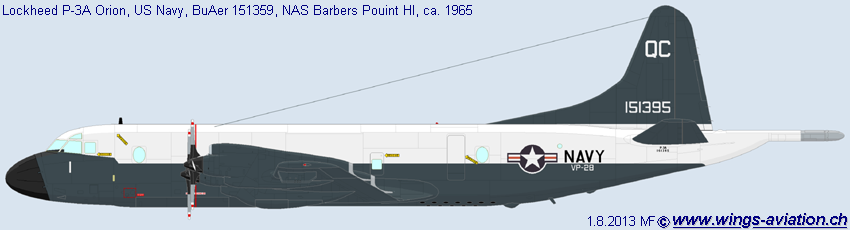
U.S. Navy
U.S. Navy
U.S. Navy
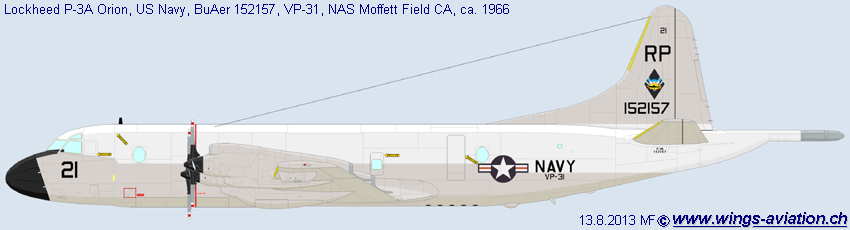
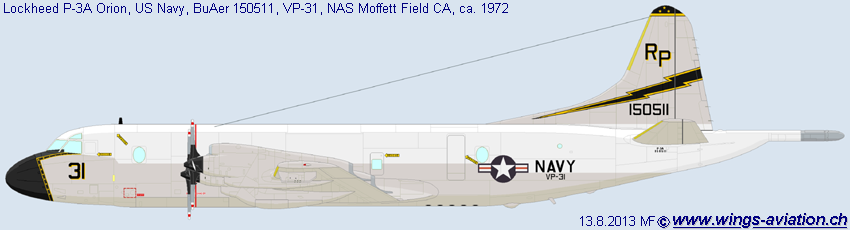
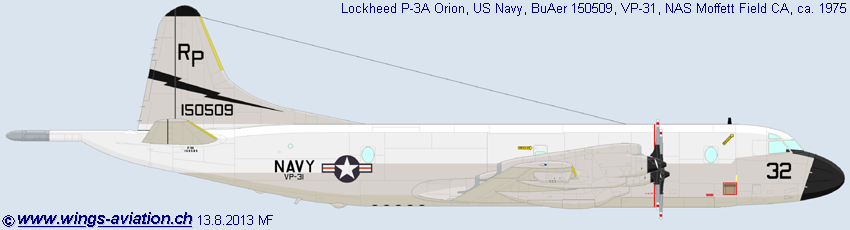
U.S. Navy
U.S. Navy
U.S. Navy
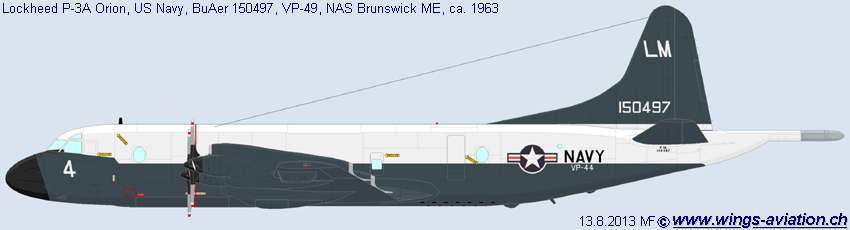
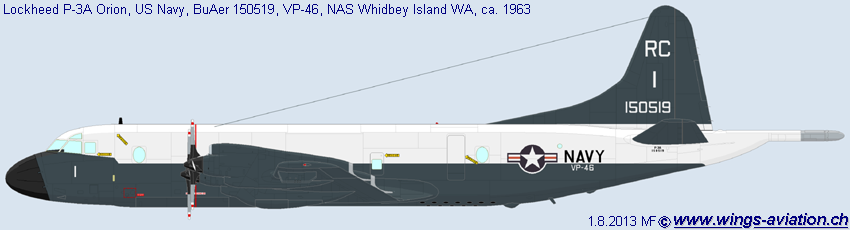
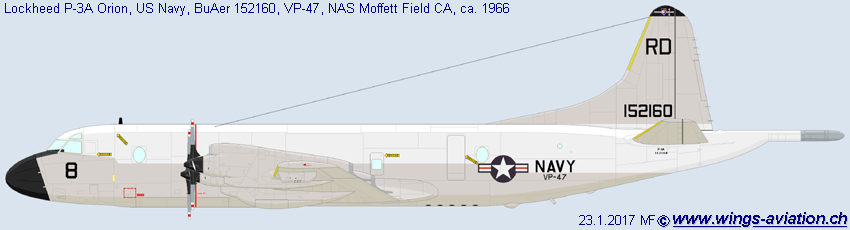
U.S. Navy
U.S. Navy
U.S. Navy
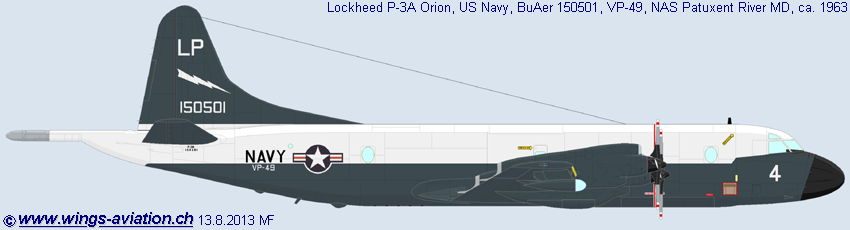
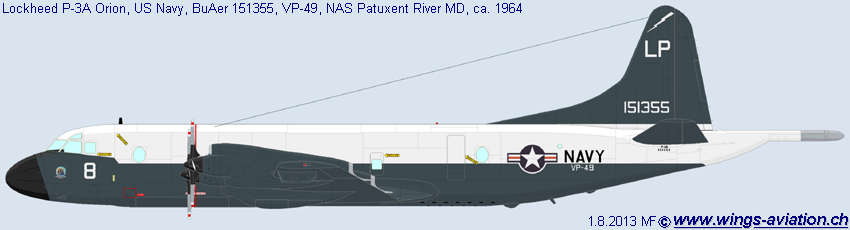
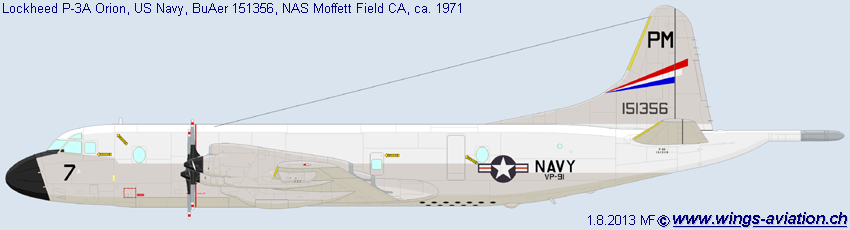
U.S. Navy
U.S. Navy
U.S. Navy
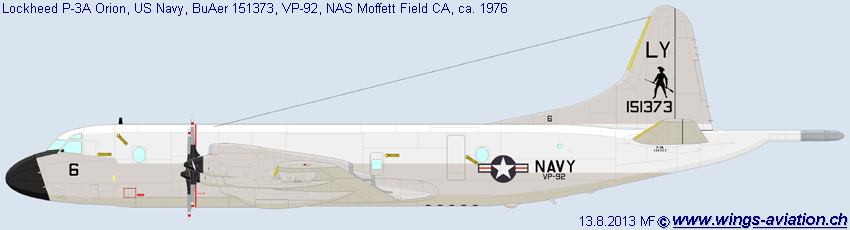
U.S. Navy
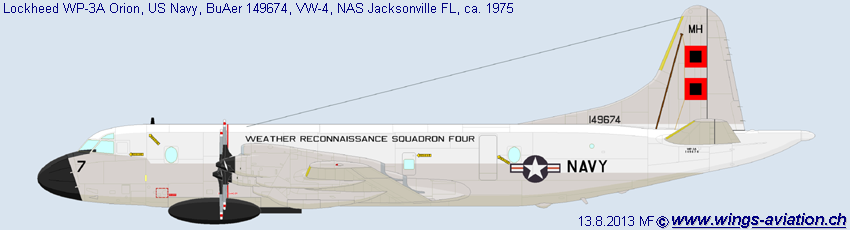
U.S. Navy
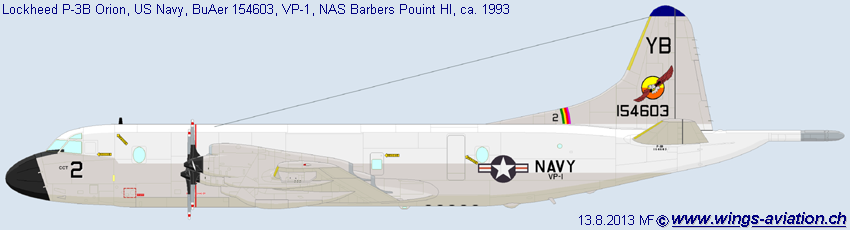
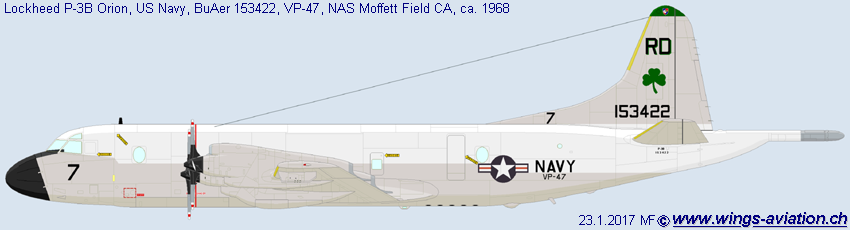
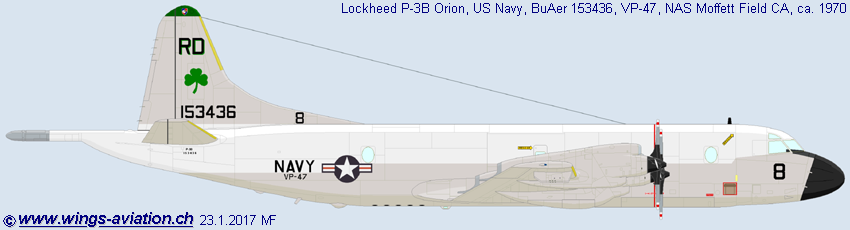
U.S. Navy
U.S. Navy
U.S. Navy
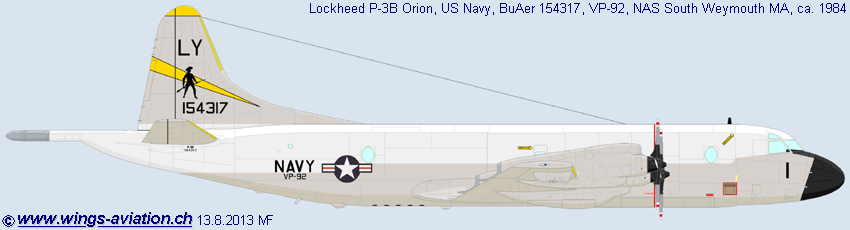
U.S. Navy
U.S. Navy
U.S. Navy

Royal Thai Navy

Royal Thai Navy
|
Text: |
- |
|
Drawings: |
Michael E. Fader |