Lockheed P-80 / F-80 Shooting Star
Military Aircraft of the World


Entwicklung
The Lockheed P-80 Shooting
Star was the first jet fighter used operationally by the United States
Army Air Forces during World War II. Designed and built by Lockheed in
1943 and delivered just 143 days from the start of design, production
models were flying.
The XP-80 had a conventional all-metal airframe with a slim, low wing
and tricycle landing gear. It was the first operational jet fighter in
which the engine was recessed into the fuselage, a format already used
on the German Heinkel He 178 V1 of 1939 and the later British Gloster
E.28/39 Demonstrator of 1941. The first prototype with the Halford H1
engine flew for the first time on 8 January 1944, with Lockheed test
pilot Milo Burcham at the controls.
The Shooting Star entered service at the end of 1944 with 12
pre-production YP-80A aircraft. A 13th YP-80A was converted into the
only F-14 photo reconnaissance model and was lost in a crash in December
1944. 1714 production aircraft were delivered to the U.S. Air Force.
Die Lockheed P-80 Shooting Star
war der erste Düsenjäger, der während des Zweiten Weltkriegs von den United
States Army Air Forces eingesetzt wurde. Die von Lockheed 1943 entworfene
und gebaute Maschine wurde nur 143 Tage nach ihrer Entwicklung ausgeliefert
und ging in Produktion.
Die XP-80 hatte eine konventionelle Ganzmetall-Zelle mit einem schlanken,
niedrigen Flügel und einem Dreiradfahrwerk. Sie war das erste einsatzfähige
Düsenjagdflugzeug, bei dem das Triebwerk im Rumpf versenkt war, ein Format,
das bereits bei der deutschen Heinkel He 178 V1 von 1939 und dem späteren
britischen Gloster E.28/39 Demonstrator von 1941 verwendet wurde. Der erste
Prototyp mit dem Halford-H1-Triebwerk flog erst-mals am 8. Januar 1944, mit
Lockheed-Testpilot Milo Burcham am Steuer.
Die Shooting Star wurde Ende 1944 mit 12 Vorserienflugzeugen vom Typ YP-80A
in Dienst gestellt. Eine 13. YP-80A wurde zum einzigen
F-14-Fotoaufklärungsmodell umgebaut und ging bei einem Absturz im Dezember
1944 verloren. 1714 Serienflugzeuge wurden an die U.S. Air Force
ausgeliefert.
Versionen
XP-80
Prototype powered by a de Havilland-built Halford H.1B turbojet, one built.
XP-80
Prototyp, angetrieben durch ein von de Havilland gebautes Halford H.1B-Turbotriebwerk, eine gebaut
XP-80A
Production prototype variant powered by a General Electric I-40 turbojet, increased span and length but wing area reduced, two built.
XP-80A
Prototyp für die Produktion, ange-trieben von einem General Electric I-40-Turbotriebwerk, grössere Spann-weite und Länge, aber kleinere Flügelfläche, zwei Exemplare.
YP-80A
12 pre-production aircraft.
YP-80A
12 Vorproduktionsflugzeuge.
XF-14
One built reconnaissance prototype
XF-14
Ein gebauter Aufklärungsprototyp
P-80A
F-80A
First production Version Fitted with 850 Liter tiptanks, 524 built
P-80A
F-80A
Erste Produktionsversion mit 850-Liter Flügeltanks, 524 Stück gebaut
EF-80
Modified to test "Prone Pilot" cockpit positions.
EF-80
Modifiziert, um die Cockpitpositionen des "liegender Pilot" zu testen.
XFP-80A
Modified P-80A with hinged nose for camera equipment.
XFP-80A
Modifizierte P-80A mit aufklappbarer Nase für Kameraausrüstung.
FP-80A
RF-80A
Photo reconnaissance aircraft.152 built
FP-80A
RF-80A
Fotoaufklärungsflugzeug.152 gebaut
ERF-80A
Modified P-80A with experimental nose contour.
ERF-80A
Modifizierte P-80A mit experimenteller Nasenkontur.
XP-80B
Reconfigured P-80A, improved J-33 engine, one built as prototype for P-80B
XP-80B
Umgestaltete P-80A, verbessertes J-33-Triebwerk, ein Exemplar wurde als Prototyp für die P-80B gebaut.
P-80B
F-80B
Model fitted with an ejection seat and J-33 engine.
P-80B
F-80B
Modell mit Schleudersitz und J-33-Triebwerk ausgestattet.
P-80R
Modification of XP-80B to racer.
P-80R
Modifizierung der XP-80B zum Rennflugzeug
P-80C
128 F-80A modified to F-80C with J-33-A-35 engine and ejection seat installed; fitted with 980 Liter tiptanks, 798 built
P-80C
128 F-80A umgerüstet auf F-80C mit J-33-A-35 Triebwerk und Schleudersitz; ausgestattet mit 980-Liter Flügeltanks, 798 gebaut
RF-80C
76 F-80A and F-80C modified to upgraded photo recon plane.
RF-80C
76 F-80A und F-80C umgebaut zu einem verbesserten Aufklärungsflugzeug.
DF-80A
Designation given to number of F-80As converted into drone directors.
DF-80A
Bezeichnung für eine Reihe von F-80A, die zu Drohnenleitern umgebaut wurden.
QF-80C
Conversions to target drones.
QF-80C
Umrüstungen zu Zieldrohnen.
TP-80C
TF-80C
First designation for the T-33 trainer prototype.
TP-80C
TF-80C
Erste Bezeichnung für den Prototyp des T-33-Trainers.
F-80B
U.S. Navy designation of P-80B, 50 transferred to USN in 1949
F-80B
Profiles
Profile

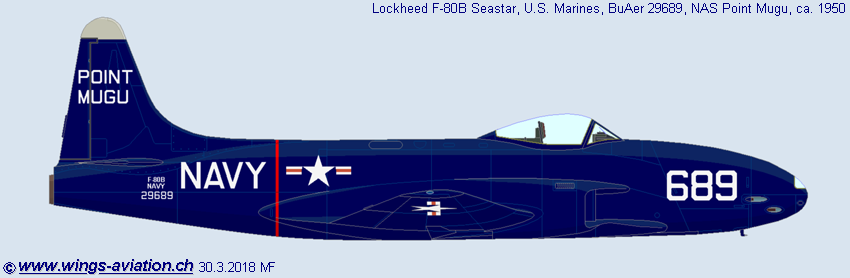

U.S. Navy
U.S. Navy
U.S. Navy

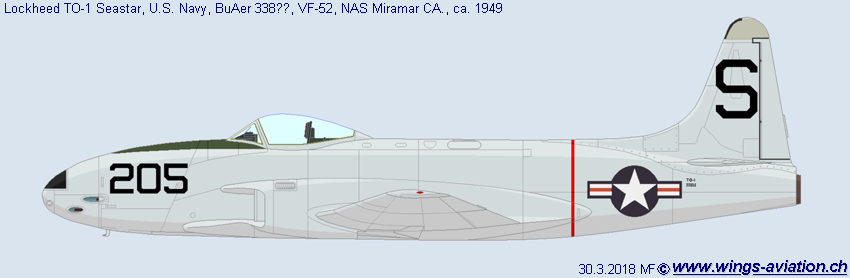

U.S. Navy
U.S. Navy
U.S. Navy


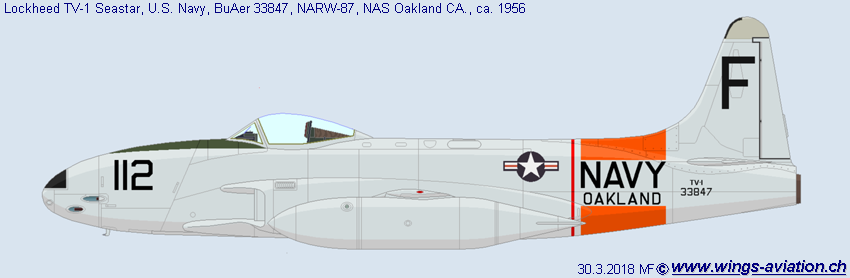
U.S. Navy
U.S. Navy
U.S. Navy


U.S. Navy
U.S. Navy
U.S. Navy
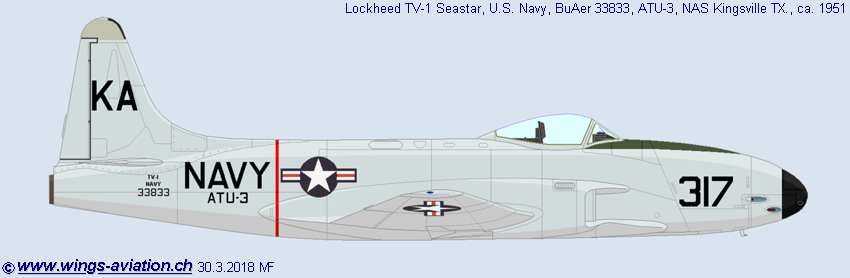

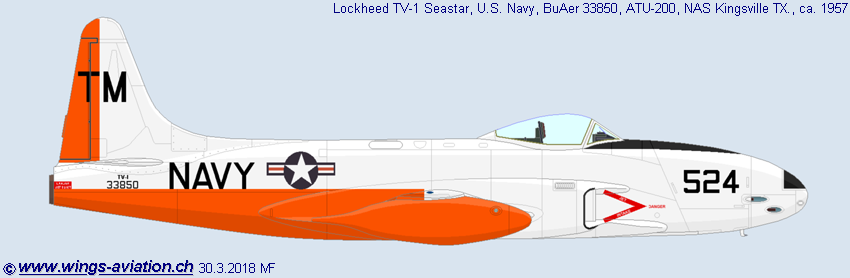
U.S. Navy
U.S. Navy
U.S. Navy

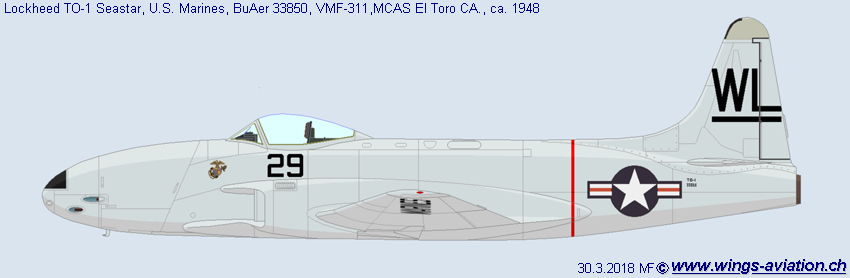

U.S. Marines
U.S. Marines
U.S. Marines
| Specifications |
F-80C |
|
|
Wingspan |
Spannweite |
11.81 m |
|
Length |
Länge |
10.49 m |
|
Height |
Höhe |
3.43 m |
|
Wing area |
Flügelfläche |
22.07 m2 |
|
Engine |
Motor |
1 × Allison J33-A-35 centrifugal compressor turbojet, 4,600 lbf thrust |
|
Maximum speed |
Höchstgeschwindigkeit |
956 km/h |
|
Empty weight |
Leergewicht |
3,819 kg |
|
Loaded weight |
Startgewicht |
7,646 kg |
|
Climb Rate |
Steigrate |
34.9 m/s |
|
Service ceiling |
Gipfelhöhe |
14,300 m |
|
Range |
Reichweite |
1,328 km |
|
Armament |
Bewaffnung |
6 × 12.7mm machine guns, ub to 900 Kg of Bombs |
|
Text: |
- |
|
Drawings: |
Michael E. Fader |