|
|
|
|
|
|
|
|
|
. |
|
North American
FJ- Fury |
. |
|
Military Aircraft of
the World |
. |
|
|
|
|
|
|
|
|
|
. |
|
 |
 |
| |
|
|
|
|
|
|
|
|
. |
|
Development |
|
Entwicklung |
|
|
The
North American FJ Fury was the first operational jet aircraft in United
States Navy service. Ordered in late 1944 as the XFJ-1 the Fury began as a
straight-wing, tricycle gear fighter with a single General Electric
J35-turbojet passing through the fuselage.
|
|
Die
North American FJ "Fury" war das erste einsatzfähige trägergestützte
Strahlflugzeug der U.S. Navy. Bestellt im Jahre 1944 als XFJ-1 war die Fury
ein konventioneller Tiefdecker mit geraden Tragflächen und einem relativ
dicken Rumpfquer-schnitt angelegt. Durch einen großen, in der Nase sitzenden
Lufteinlass wurde ein General Electric J35-Triebwerk versorgt.
|
| |
FJ-1
The
first flight of the prototype XFJ-1 took place on September 11, 1946, with
the first of thirty deliveries beginning in October of 1947. The Fury's
first landing on an aircraft carrier was made 10th March 1948 aboard USS
Boxer. Flown operationally only by Navy squadron VF-5A
|
|
FJ-1
Die
erste XFJ-1 startete am 11. September 1946 zu ihrem Jungfernflug. 30
Maschinen wurden ab dem Oktober 1947 an die Navy ausgeliefert. Die Fury
machte am 10. März 1948 die erste Landung auf einem Flugzeugträger der
CV-21 USS Boxer. Im Einsatz wurde die Fury nur von der Staffel VF-5A
verwendet.
|
|
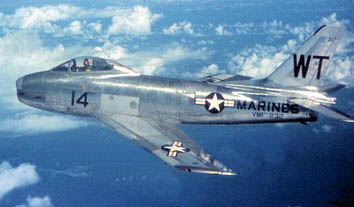
FJ-2
By 1951, the Navy's existing
straight-wing fighters were inferior in performance to the swept-wing
Soviet Mikoyan-Gurevich MiG-15 then operating in the Korean War; the
swept-wing fighters in the Navy's development pipeline, such as the
Vought F7U Cutlass and Grumman F9F Cougar, were not yet ready for
deployment. As an interim measure, the Navy's Bureau of Aeronautics
ordered a direct development of the swept-wing North American F-86E
Sabres as the FJ-2.
|
|
FJ-2
Bis 1951 waren die
vorhandenen Jäger der Marine mit geraden Flügeln der sowjetischen
Mikojan-Gurewitsch-MiG-15 mit Pfeilflügeln, die damals im Koreakrieg
eingesetzt wurde, in ihrer Leistung unterlegen. Die Pfeilflügeljäger in
der Entwicklung der Marine, wie der Vought F7U Cutlass und der Grumman
F9F Cougar, waren noch nicht einsatz-bereit. Als vorläufige Massnahme
ordnete das Bureau of Aeronautics der Navy eine direkte Ent-wicklung der
North American F-86E Sabres mit Pfeilflügeln als FJ-2 an. |
|
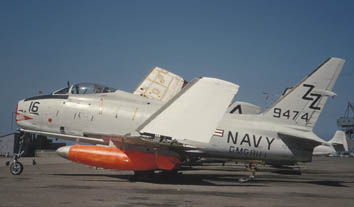
FJ-3
Even while development of
the FJ-2 was ongoing, the development was planned of a version powered
by the Wright J65, a license-built version of the British Armstrong
Siddeley Sapphire turbojet. The Sapphire promised to deliver 28% more
thrust than the J47, for little gain in weight. The new version was
designated FJ-3, and an order for 389 aircraft was placed in March 1952.
|
|
FJ-3
Noch während die Entwicklung
des FJ-2 andauerte, war die Entwicklung einer Version geplant, die vom
Wright J65 angetrieben wurde, einer lizenzierten Version des britischen
Armstrong Siddeley Sap-phire Turbojets. Der Sapphire versprach, 28 %
mehr Schub als der J47 bei geringer Gewichts-zunahme zu liefern. Die
neue Version wurde als FJ-3 bezeichnet und im März 1952 wurden 389
Flugzeuge bestellt. |
|
FJ-4
The
final development, the FJ-4 shared its general layout and engine with
the earlier FJ-3, but featured an entirely new wing design and was a
vastly different design in its final embodiment.
The FJ-4 was intended as an all-weather interceptor, a role that
required considerable range on internal fuel. The FJ-4 had 50% more fuel
capacity than the FJ-3 and was lightened by omitting armor and reducing
ammunition capacity. The fuselage was deepened to add more fuel, and had
a distinctive "razorback" rear deck. A modified cockpit made the pilot
more comfortable. The tail surfaces were also extensively modified and
had a thinner profile. The overall changes resulted in an aircraft that
had little in common with the earlier models. The two prototypes had the
same Wright J65-W-4 engine as the FJ-3, but production aircraft had the
J65-W-16A of 7,700 lbf thrust.
|
|
FJ-4
Die endgültige Entwicklung,
der FJ-4, teilte sein allgemeines Layout und seinen Motor mit der
früheren FJ-3, wies jedoch ein völlig neues Flügel-design auf und war in
seiner endgültigen Aus-führungsform ein völlig anderes Design.
Der FJ-4 war als Allwetter-Abfangjäger gedacht, eine Rolle, die eine
beträchtliche Reichweite mit internem Treibstoff erforderte. Der FJ-4
hatte 50% mehr Treibstoffkapazität als der FJ-3 und wurde durch
Weglassen der Panzerung und Reduzierung der Munitionskapazität leichter.
Der Rumpf wurde vertieft, um mehr Treibstoff hinzuzufügen, und hatte ein
charakteristisches "Razorback" Rumpf. Ein modifiziertes Cockpit machte
den Piloten komfort-abler. Die Heckflächen wurden ebenfalls umfas-send
modifiziert und hatten ein dünneres Profil. Die allgemeinen Änderungen
führten zu einem Flugzeug, das mit den früheren Modellen wenig
ge-meinsam hatte. Die beiden Prototypen hatten das gleiche Wright
J65-W-4-Triebwerk wie die FJ-3, aber Serienflugzeuge hatten die
J65-W-16A mit 7.700 lbf Schub. |
| |
|
|
|
|
|
|
|
|
. |
|
Variants |
|
Versionen |
|
|
XFJ-1
|
Three
prototype. |
|
XFJ-1
|
Drei
Prototypen. |
|
FJ-1
|
Initial
production Version. (30 built) |
|
FJ-1
|
Erste
Produktionsphase 30 Maschinen |
|
XFJ-2
|
Two
prototype |
|
XFJ-2
|
Zwei
Prototypen |
|
XFJ-2B
|
one
prototype armed with 20 mm Canons |
|
XFJ-2B
|
Ein
Prototype mit 20 mm Kanonenbewaffnung |
|
FJ-2
|
Single-seat fighter-bomber
aircraft, equipped with folding wings; powered by one General Electric
J47-GE-2 turbojet; 200 built. |
|
FJ-2
|
Einsitziges Jagdbomberflugzeug,
ausgestattet mit Klappflügeln; ange-trieben von einem General Electric
J47-GE-2 Turbojet; 200 gebaut. |
|
FJ-3
F-1C
|
Single-seat fighter-bomber
version, powered by the more powerful 7,800 lbf Wright J65-W-2 turbojet
engine; 538 built. |
|
FJ-3
F-1C
|
Einsitzige Jagdbomberversion,
angetrieben von dem stärkeren 7.800 lbf Wright J65-W-2 Turbojet-Triebwerk;
538 gebaut. |
|
FJ-3M
MF-1C
|
Improved version of the FJ-3,
with the ability to carry AIM-9 Sidewinder air-to-air missiles; 194 FJ-3
converted to this standard. |
|
FJ-M
MF-1C
|
Verbesserte Version des FJ-3 mit
der Fähigkeit, AIM-9 Sidewinder-Luft-Luft-Raketen zu tragen; 194 FJ-3 auf
diesen Standard umgestellt. |
|
FJ-3D
DF-1C
|
Conversions to control aircraft
for SSM-N-8 Regulus missiles and KDU target drones. |
|
FJ-3D
DF-1C
|
Umbauten zur Steuerung von
SSM-N-8 Regulus-Raketen und KDU-Zieldrohnen. |
|
FJ-3D2
DF-1D
|
Conversions to control aircraft
for Grumman F9F-6K Cougar target drones. |
|
FJ-3D2
DF-1D
|
Umbauten zur Steuerung von
Zieldrohnen Grumman F9F-6K Cougar. |
|
XFJ-4 |
Two prototypes with a J65-W-4
engine and redesigned fuselage. |
|
XFJ-4 |
Zwei Prototypen mit
J65-W-4-Motor und neu gestaltetem Rumpf. |
|
YFJ-4 |
One FJ-4 used for development
testing |
|
YFJ-4 |
Eine FJ-4 für Entwicklungstests |
|
FJ-4
F-1E
|
Single-seat fighter-bomber
version, powered by a 7,700 lbf Wright J65-W-16A turbojet engine, 150 built. |
|
FJ-4
F-1E
|
Einsitzige Jagdbomberversion,
angetrieben von einem Wright J65-W-16A-Turbostrahltriebwerk mit 7.700 lbf,
150 gebaut. |
|
FJ-4B
AF-1E
|
Single-seat ground-attack close
support version with six underwing pylons, 222 built. |
|
FJ-4B
AF-1E
|
Einsitzige
Nahunterstützungsversion für Bodenangriffe mit sechs Unter-flügelstationen,
222 gebaut. |
|
|
|
|
|
|
|
|
|
.. |
|
Profiles |
|
Profile |
|
|
FJ-1 |
|
|
 |
 |
 |
| |
U.S. Navy |
U.S. Navy |
U.S. Navy |
|
|
 |
 |
 |
| |
U.S. Navy |
U.S. Navy |
U.S. Navy |
|
|
FJ-2 |
|
|
 |
 |
 |
|
U.S. Navy |
U.S. Navy |
U.S. Navy |
|
|
 |
 |
 |
|
U.S. Navy |
U.S. Navy |
U.S. Navy |
|
|
 |
 |
 |
| |
U.S. Marines |
U.S. Marines |
U.S. Marines |
|
|
 |
 |
 |
| |
U.S. Marines |
U.S. Marines |
U.S. Marines |
|
|
 |
 |
 |
|
U.S. Marines |
U.S. Marines |
U.S. Marines |
|
|
 |
 |
 |
|
U.S. Marines |
U.S. Marines |
U.S. Marines |
|
|
 |
 |
 |
|
U.S. Marines |
U.S. Marines |
U.S. Marines |
|
|
FJ-3 & FJ-3M |
|
|
 |
 |
 |
| |
U.S. Navy |
U.S. Navy |
U.S. Navy |
|
|
 |
 |
 |
| |
U.S. Navy |
U.S. Navy |
U.S. Navy |
|
|
 |
 |
 |
| |
U.S. Navy |
U.S. Navy |
U.S. Navy |
|
 |
 |
 |
|
U.S. Navy |
U.S. Navy |
U.S. Navy |
|
|
 |
 |
 |
| |
U.S. Navy |
U.S. Navy |
U.S. Navy |
|
|
 |
 |
 |
| |
U.S. Navy |
U.S. Navy |
U.S. Navy |
|
|
 |
 |
 |
| |
U.S. Navy |
U.S. Navy |
U.S. Navy |
|
|
 |
 |
 |
|
U.S. Navy |
U.S. Navy |
U.S. Navy |
|
|
 |
 |
 |
| |
U.S. Navy |
U.S. Navy |
U.S. Navy |
|
|
 |
 |
 |
| |
U.S. Navy |
U.S. Navy |
U.S. Navy |
|
|
 |
 |
 |
| |
U.S. Navy |
U.S. Navy |
U.S. Navy |
|
|
 |
 |
 |
| |
U.S. Navy |
U.S. Navy |
U.S. Navy |
|
|
 |
 |
 |
|
U.S. Navy |
U.S. Navy |
U.S. Navy |
|
|
 |
 |
 |
| |
U.S. Navy |
U.S. Navy |
U.S. Navy |
|
|
 |
 |
 |
| |
U.S. Navy |
U.S. Navy |
U.S. Navy |
|
|
 |
 |
 |
| |
U.S. Navy |
U.S. Navy |
U.S. Navy |
|
|
 |
 |
 |
|
U.S. Navy |
U.S. Navy |
U.S. Navy |
|
|
 |
 |
 |
| |
U.S. Navy |
U.S. Navy |
U.S. Navy |
|
|
 |
 |
 |
| |
U.S. Navy |
U.S. Navy |
U.S. Navy |
|
|
 |
 |
 |
| |
U.S. Navy |
U.S. Navy |
U.S. Navy |
|
|
 |
 |
 |
| |
U.S. Navy |
U.S. Navy |
U.S. Navy |
|
|
 |
 |
 |
| |
U.S. Navy |
U.S. Navy |
U.S. Navy |
|
|
 |
 |
 |
| |
U.S. Navy |
U.S. Navy |
U.S. Navy |
|
|
 |
 |
 |
| |
U.S. Navy |
U.S. Navy |
U.S. Navy |
|
|
 |
 |
 |
|
U.S. Navy |
U.S. Navy |
U.S. Navy |
|
|
 |
 |
 |
|
U.S. Navy |
U.S. Navy |
U.S. Navy |
|
|
 |
 |
 |
|
U.S. Navy |
U.S. Navy |
U.S. Navy |
|
|
 |
 |
 |
|
U.S. Navy |
U.S. Navy |
U.S. Navy |
|
|
 |
 |
 |
|
U.S. Navy |
U.S. Navy |
U.S. Navy |
|
|
 |
 |
 |
|
U.S. Navy |
U.S. Navy |
U.S. Navy |
|
|
 |
 |
 |
|
U.S. Navy |
U.S. Navy |
U.S. Navy |
|
|
 |
 |
 |
|
U.S. Navy |
U.S. Navy |
U.S. Navy |
|
|
 |
 |
 |
|
U.S. Navy |
U.S. Navy |
U.S. Navy |
|
|
 |
 |
 |
|
U.S. Navy |
U.S. Navy |
U.S. Navy |
|
|
 |
 |
 |
|
U.S. Navy |
U.S. Navy |
U.S. Navy |
|
|
 |
 |
 |
|
U.S. Marines |
U.S. Marines |
U.S. Marines |
|
|
 |
 |
 |
|
U.S. Marines |
U.S. Marines |
U.S. Marines |
|
|
 |
 |
 |
| |
U.S. Marines |
U.S. Marines |
U.S. Marines |
|
|
 |
 |
 |
|
U.S. Marines |
U.S. Marines |
U.S. Marines |
|
|
FJ-4 & FJ-4B |
|
|
 |
 |
 |
| |
U.S. Navy |
U.S. Navy |
U.S. Navy |
|
|
 |
 |
 |
| |
U.S. Navy |
U.S. Navy |
U.S. Navy |
|
|
 |
 |
 |
| |
U.S. Navy |
U.S. Navy |
U.S. Navy |
|
|
 |
 |
 |
|
U.S. Navy |
U.S. Navy |
U.S. Navy |
|
|
 |
 |
 |
| |
U.S. Navy |
U.S. Navy |
U.S. Navy |
|
|
 |
 |
 |
| |
U.S. Navy |
U.S. Navy |
U.S. Navy |
|
|
 |
 |
 |
| |
U.S. Navy |
U.S. Navy |
U.S. Navy |
|
|
 |
 |
 |
| |
U.S. Navy |
U.S. Navy |
U.S. Navy |
|
|
 |
 |
 |
| |
U.S. Navy |
U.S. Navy |
U.S. Navy |
|
|
 |
 |
 |
| |
U.S. Navy |
U.S. Navy |
U.S. Navy |
|
|
 |
 |
 |
|
U.S. Navy |
U.S. Navy |
U.S. Navy |
|
|
 |
 |
 |
|
U.S. Navy |
U.S. Navy |
U.S. Navy |
|
|
 |
 |
 |
|
U.S. Navy |
U.S. Navy |
U.S. Navy |
|
|
 |
 |
 |
|
U.S. Navy |
U.S. Navy |
U.S. Navy |
|
|
 |
 |
 |
|
U.S. Navy |
U.S. Navy |
U.S. Navy |
|
|
 |
 |
 |
|
U.S. Navy |
U.S. Navy |
U.S. Navy |
|
|
 |
 |
 |
|
U.S. Navy |
U.S. Navy |
U.S. Navy |
|
|
 |
 |
 |
|
U.S. Navy |
U.S. Navy |
U.S. Navy |
|
|
 |
 |
 |
|
U.S. Navy |
U.S. Navy |
U.S. Navy |
|
|
 |
 |
 |
|
U.S. Navy |
U.S. Navy |
U.S. Marines |
|
|
 |
 |
 |
|
U.S. Marines |
U.S. Marines |
U.S. Marines |
|
|
 |
 |
 |
| |
U.S. Marines |
U.S. Marines |
U.S. Marines |
|
|
 |
 |
 |
|
U.S. Marines |
U.S. Marines |
U.S. Marines |
|
|
 |
 |
 |
|
U.S. Marines |
U.S. Marines |
U.S. Marines |
|
|
 |
 |
 |
| |
U.S. Marines |
U.S. Marines |
U.S. Marines |
|
|
 |
 |
 |
|
U.S. Marines |
U.S. Marines |
U.S. Marines |
|
|
|
|
|
|
|
|
|
. |
| |
| Specifications |
FJ-2 |
|
Wingspan |
Spannweite |
11.31
m |
|
Length |
Länge |
11.45
m |
|
Height |
Höhe |
4.14
m |
|
Wing
area |
Flügelfläche |
26.75
m2 |
|
Engine |
Motor |
Wright
J47-GE-2
2,700
kp thrust |
|
Maximum
speed |
Höchstgeschwindigkeit |
970
Km/h |
|
Empty
weight |
Leergewicht |
5,355
kg |
|
Loaded
weight |
Startgewicht |
8,525
kg |
|
Climb
Rate |
Steigrate |
? |
|
Service
ceiling |
Gipfelhöhe |
12,700
m |
|
Range |
Reichweite |
1,595
km |
|
Armament |
Bewaffnung |
4
× 20 mm cannons
2
× AIM-9 Missiles |
|
Capacity |
Zuladung |
1 pilot |
|
|
|
|
|
|
|
|
|
|
|
. |
|
|
|
Text: |
Michael E. Fader |
|
Drawings: |
Michael E. Fader |
|
|
|
|
|
|
|
|
|
|
|
. |