Victa Airtourer
Aircaft in Detail

Entwicklung
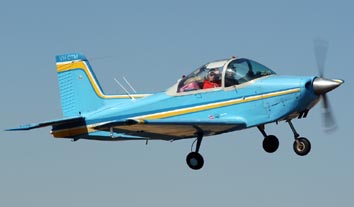
The Victa Airtourer is an
all-metal light low-wing monoplane touring aircraft that was developed
in Australia, and was manufactured in both Australia and New Zealand.
The Airtourer design is of cantilever low-wing monoplane configuration,
with a fixed tricycle landing gear. It has interconnected ailerons and
flaps, with both systems functioning as both ailerons and as flaps when
operated. The nosewheel was steerable. Space was available for luggage
(45 kg weight limit):
The manufacturing rights to the Airtourer were purchased by the
maintenance firm Aero Engine Services Ltd (AESL) in New Zealand where
further production of 115 hp and 150 hp models took place until 1973.
AESL acquired the rights to the design in 1970 and it was used to form
the basis of the CT/4 Airtrainer.
Die Victa Airtourer ist ein
vollständig aus Metall gefertigtes, leichtes, einmotoriges Reiseflugzeug mit
niedrigen Tragflächen, das in Australien entwickelt und sowohl in Australien
als auch in Neuseeland hergestellt wurde.
Das Design des Airtourer ist eine freitragende Tiefdecker-Konfiguration mit
einem festen Dreirad-fahrwerk. Es verfügt über miteinander verbundene
Querruder und Klappen, wobei beide Systeme bei Betätigung sowohl als
Querruder als auch als Klappen fungieren. Das Bugrad war lenkbar. Es stand
Platz für Gepäck (Max. 45 kg) zur Verfügung:
Die Herstellungsrechte für den Airtourer wurden von der Wartungsfirma Aero
Engine Services Ltd (AESL) in Neuseeland erworben, wo bis 1973 weitere
Modelle mit 115 PS und 150 PS produziert wurden. AESL erwarb 1970 die Rechte
an dem Design, das als Grundlage für den CT/4 Airtrainer diente.
Versionen
Profiles
Profile


Royal New Zealand Air Force
Royal New Zealand Air Force
Royal Thai Police

Royal Thai Police
| Specifications | T6/24 | |
|
Wingspan |
Spannweite |
7.92 m |
|
Length |
Länge |
6.33 m |
|
Height |
Höhe |
2.30 m |
| Wing area | Flügelfläche | 11.98 m2 |
|
Engine |
Motor |
1× Lycoming O-320-E1A piston engine, 150 hp |
|
Maximum speed |
Höchstgeschwindigkeit |
229 km/h |
|
Empty weight |
Leergewicht |
490 kg |
|
Loaded weight |
Startgewicht |
749 kg |
|
Climb Rate |
Steigrate |
? |
|
Service ceiling |
Gipfelhöhe |
4,267 m |
|
Range |
Reichweite |
1'285 km |
|
Armament |
Bewaffnung |
none |
|
Capacity |
Zuladung | pilot 1, 1 passengers |
|
Text: |
- |
|
Drawings: |
Michael E. Fader |
|
Pictures: |
- |