Lockheed C-130 Hercules
Aircaft in Detail
Entwicklung
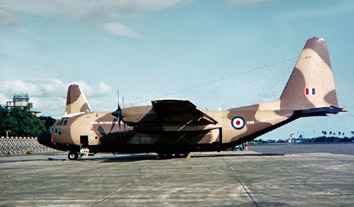
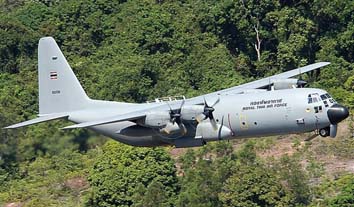
The first flight of the YC-130 prototype was made on 23 August 1954 from the Lockheed plant in Burbank, California. The initial production model, the C-130A, was powered by Allison T56-A-9 turboprops with three-blade propellers and originally equipped with the blunt nose of the prototypes. Deliveries began in December 1956, continuing until the introduction of the C-130B model in 1959. Some A-models were equipped with skis and re-designated LC-130D. As the C-130A became operational with Tactical Air Command, the C-130's lack of range became apparent and additional fuel capacity was added in the form of external pylon-mounted tanks at the end of the wings.
Der Erstflug des YC-130-Prototyps erfolgte am 23. August 1954 vom Lockheed-Werk in Burbank, Kalifornien. Das ursprüngliche Serienmodell, der C-130A, wurde von Allison T56-A-9 Turboprops mit Drei-Blatt-Propeller angetrieben und ursprünglich mit der stumpfen Nase der Prototypen ausgestattet. Die Aulieferung begann im Dezember 1956 und dauerte bis zur Einführung des Modells C-130B im Jahr 1959. Einige A-Modelle wurden mit Skiern ausgestattet und in LC-130D umbenannt. Als die C-130A mit dem Tactical Air Command einsatzfähig wurde, wurde die fehlende Reichweite der C-130 sichtbar und zusätzliche Treib-stoffkapazität wurde in Form von externen montier-ten Tanks am Ende der Tragflächen hinzugefügt.
Profiles
Profile


| Specifications | C-130H | |
|
Wingspan |
Spannweite |
40.40 m |
|
Length |
Länge |
29.80 m |
|
Height |
Höhe |
11.60 m |
| Wing area | Flügelfläche | 162.10 m² |
|
Engine |
Motor |
4× Allison T56-A-15 turboprops, 4,590 shp each |
|
Maximum speed |
Höchstgeschwindigkeit |
592 km/h |
|
Empty weight |
Leergewicht |
34,400 kg |
|
Loaded weight |
Startgewicht |
70,300 kg |
|
Climb Rate |
Steigrate |
9.3 m/s |
|
Service ceiling |
Gipfelhöhe |
10,060 m |
|
Range |
Reichweite |
3,800 km |
|
Armament |
Bewaffnung |
none |
|
Capacity |
Zuladung |
Crew 5 64 airborne troops |
|
Text: |
- |
|
Drawings: |
Michael E. Fader |
|
Pictures: |
- |